The current political situation in Andhra Pradesh is somewhat charged. The western region of the state, called Telangana, comprises 10 out of AP’s 23 districts, and includes the capital city, Hyderabad. Claiming unfair treatment from the state government, the people and political parties of that area have been agitating to separate and form a new Telangana state. It’s true that water and other resources are scarce there, but it seems to me that they are scarce in other areas of the state that I have visited as well. At any rate, the Telangana Rashtra Samithi (TRS) is the main political party fighting for this separation. They’ve been organizing bandhs, which are basically all-encompassing strikes, for the last year. These strikes happen at least every week, and everything from schools to buses to hospitals throughout the Telangana area has to be shut down under threat of violence if they don’t comply. That’s the background of the situation.
Now, the first week and a half that I was at Matendla, everything was peaceful and calm. But in the middle of the second week, we had some visitors from TRS on the morning of a bandh . Three guys came in to the school and asked Vishnu, the headmaster, to shut everything down. We could see them talking from the opposite wing of the school, and some teachers told us what was going on. The teachers were somewhat tense, because they didn’t want to waste a day of school. Yet they trusted the headmaster to deal with the situation.
Vishnu is enthusiastic and idealistic and cares very much about the students. He is also very good at showing that to other people and infecting them with his ideas. He somehow managed to convince the TRS people that canceling school here in a remote village would not only do no good for the bandh, but would also be detrimental to the students. If Telangana is to get out of its current situation, he argued, it has to have educated people. And they listened.
But they didn’t give up that easily. The idea of the bandh seemed abandoned, but they asked if instead, they could sign the students up for the TRS. Once again, Vishnu used his quiet logic on them. The students are young, but they must make that decision for themselves. But you can talk to them and tell them why you think they should join, he conceded.
nd with that, everybody let out a collective breath of relief. School would not be canceled. The 10th graders were taken into a nearby room to listen to the TRS folks, but the rest of the classes continued as planned.
The thing that strikes me is that this wasn’t a one-off situation. It had happened before and would almost certainly happen in the future again. Vishnu’s argument worked this time, but apparently that hasn’t always been the case. And what if the school had been located somewhere less remote? What of the urban schools in Hyderabad? Hyderabad is the center of the state, and schools there have lost an immense amount of teaching time to these bandhs, because they can’t argue that they are far away. It makes me angry that children and students have to suffer the consequences of this political action. These strikes only happen in the Telangana areas. How could it possibly help your people to deprive them of necessary services (hospitals and public transportation for the many people who don’t have their own vehicles)? All they are doing is setting their own students back.
I think that Vishnu and the teachers must have felt the same way I did. They’ve dedicated their careers to helping kids gain some education in a place where the previous generation was mostly married by 14 and out of school long before then. But they can’t voice their sentiments, because of the potential consequences.
I think that maybe their conviction that the students must be taught to make their own choices plays into it as well. Now that I think about it, I think that Vishnu twisted the situation around and turned it into a learning experience for the students. The students listened to the TRS people, discussed it amongst themselves (with no teachers present), and told them that for the moment, school was important. Those of the student body who wanted to help the TRS would meet them after school to learn more about what they could do, but they would not give up their school time.
So perhaps it’s not all bad. Having a charged political situation that affects them means that the students have to think more about politics. The students will be more interested in how the whole state is working, rather than focusing on their surroundings. Some of them have not been further than 10 km from their village, so this exposes them to issues that affect a much larger area. So I guess whatever the situation is at hand, if you have good teachers and a good attitude, you can make anything into a learning experience for the students.
Tuesday, September 14, 2010

Friday, September 10, 2010
To the Students:
Now I've had more than a month to think about things since my project ended, and other education-related events have kept me thinking about it (along with, of course, the necessity of finishing my blog record of my practice). So in the end, this is the advice I'd give to the students:
For math, science, etc.: Don't memorize the answers from the guides. Learn the material and the principles behind the material, and you will be able to solve any problem they throw at you. As an added bonus (though it should be the actual motivation), you'll actually be able to use your newfound skills in the real world, when there is no guidebook to give you answers.
For languages: Read. Next to living in a foreign country where you're immersed in the language, the best thing you can do to learn a language is read. It improves not only your vocabulary, but also your knowledge of sentence structures and idiomatic usage. With enough exposure, these things will get shoved into your subconscious mind, and creating your own sentences will be infinitely more easy.
In general: You all work very hard because you really want to learn. Keep that desire to learn, because the number of things you don't know will always be greater than the number of things you do know. Work on being able to solve problems on your own, based on what you know. Even if you can't see the whole pathway to the solution, do what you know, and see if that gets you anywhere.
The system beats creativity out of you, but always try to draw your own links and figure out how everything is connected. Place what you learn into context with what you've learned in other subjects. Make the information you're learning real for yourself.
For math, science, etc.: Don't memorize the answers from the guides. Learn the material and the principles behind the material, and you will be able to solve any problem they throw at you. As an added bonus (though it should be the actual motivation), you'll actually be able to use your newfound skills in the real world, when there is no guidebook to give you answers.
For languages: Read. Next to living in a foreign country where you're immersed in the language, the best thing you can do to learn a language is read. It improves not only your vocabulary, but also your knowledge of sentence structures and idiomatic usage. With enough exposure, these things will get shoved into your subconscious mind, and creating your own sentences will be infinitely more easy.
In general: You all work very hard because you really want to learn. Keep that desire to learn, because the number of things you don't know will always be greater than the number of things you do know. Work on being able to solve problems on your own, based on what you know. Even if you can't see the whole pathway to the solution, do what you know, and see if that gets you anywhere.
The system beats creativity out of you, but always try to draw your own links and figure out how everything is connected. Place what you learn into context with what you've learned in other subjects. Make the information you're learning real for yourself.
Sunday, August 29, 2010
Campfire Stories
Here's another horror story about the educational system for you. This time, it's about college.
One of the teachers was acting as an examiner in another college for the B.Sc Chemistry students. They were being asked to do a titration. Each would go into the chemical room and come out with a little pile of white powder. When asked the mass, they would reply that it was 23.1457 g.
When multiple students came out telling her the same weight, or similar weights with an odd number for the last digit, she became curious. All the balances her own college had were two-pan balances with the smallest measure being 0.2 mg. So she was curious what kind of balance they were using that could go down to 0.1 mg. Most colleges don't have that kind of balance.
Neither did this one. In fact, this college didn't have any kind of balance. The students were going into the chemical store room, where some guy was handing them spoonfuls of the compound. They knew the number they were supposed to say, and so they said it.
So how did they do titration without knowing the concentration of their solution? Same way. They would do whatever they were doing with their burettes, then come up to the teacher and say, "Ma'am, I got 15.3 mL," which would be the correct answer. There was absolutely no real titration going on.

For the vast majority of the students, this practical exam was probably the second time in their lives they had touched a burette, with the first being probably no more than a week before. All the practicals are often crammed into one week before the test, and then forgotten, if they ever were learned to begin with.
It's ridiculous to even contemplate teaching science this way. No wonder companies don't want to hire graduates that know nothing and need to be trained from the beginning, which makes finding jobs difficult for science graduates, which makes people less likely to go with the science track after 10th which makes for less funding for these colleges. It really is a vicious cycle.
Part of the problem, I think, is that research and teaching have been uncoupled. The electrons (ideas, capital) might be flowing in from the government or industry in the research world, but ATP synthesis (college lab) has nothing to power it. Plus half the protons (money) flow right back out the pores of corruption.
One of the teachers was acting as an examiner in another college for the B.Sc Chemistry students. They were being asked to do a titration. Each would go into the chemical room and come out with a little pile of white powder. When asked the mass, they would reply that it was 23.1457 g.
When multiple students came out telling her the same weight, or similar weights with an odd number for the last digit, she became curious. All the balances her own college had were two-pan balances with the smallest measure being 0.2 mg. So she was curious what kind of balance they were using that could go down to 0.1 mg. Most colleges don't have that kind of balance.
Neither did this one. In fact, this college didn't have any kind of balance. The students were going into the chemical store room, where some guy was handing them spoonfuls of the compound. They knew the number they were supposed to say, and so they said it.
So how did they do titration without knowing the concentration of their solution? Same way. They would do whatever they were doing with their burettes, then come up to the teacher and say, "Ma'am, I got 15.3 mL," which would be the correct answer. There was absolutely no real titration going on.

For the vast majority of the students, this practical exam was probably the second time in their lives they had touched a burette, with the first being probably no more than a week before. All the practicals are often crammed into one week before the test, and then forgotten, if they ever were learned to begin with.
It's ridiculous to even contemplate teaching science this way. No wonder companies don't want to hire graduates that know nothing and need to be trained from the beginning, which makes finding jobs difficult for science graduates, which makes people less likely to go with the science track after 10th which makes for less funding for these colleges. It really is a vicious cycle.
Part of the problem, I think, is that research and teaching have been uncoupled. The electrons (ideas, capital) might be flowing in from the government or industry in the research world, but ATP synthesis (college lab) has nothing to power it. Plus half the protons (money) flow right back out the pores of corruption.
Friday, August 27, 2010
Day 30 - The End
Today is our last day here. And apparently there's a bandh going on. Ummm...I really hope that doesn't mean school is canceled and we don't get to do all our experiments. If the TRS (Telangana Rasthra Samithi), the party agitating for a separate Telangana, gets to the school before first period, it might be. Once school starts, though, the principal won't stop it again.
He has a good argument for the TRS too. Once the cooks start making lunch, it would be a huge waste of money and food to get rid of all they've cooked. And the TRS people around here seem to understand that the RDF is serious about teaching the kids, and that interrupting school is not the best way to advance Telangana's interests.
Just in case, though, we decide to teach the 6th graders first. They've been asking for us to come to their class for days, and we haven't yet done any experiments with them. It screws up the schedule a bit, but we really want to work with them.
I do the same magnetism spiel from two days ago, but simplify. I emphasize the attraction/repulsion a bit more since they haven't really learned it yet. I have each person in the group try to push like poles of the bar magnets together, and they giggle with glee as each successive person fails to touch the two ends. "Arey, adey kaduluthondi!" (Hey, it's moving by itself!)
My mom was planning to just show them electroplating, but she ends up doing it the same way she did it with the other classes, by assigning each student in the group to hold a wire or a coin, or to observe the coin and tell us when it has turned red enough to break the circuit. It gets them more involved, and they feel like science is something they can do, so that's okay.

For 4th period, we do both sections of 9th. We call them over to the lab and demonstrate the iodine clock. I pour everything in and tell them it's the pindi padhartham (iodine-starch test). Then I ask, why isn't it changing colors? About 20 seconds later, I draw their attention back to the tube, and they gasp as it suddenly begins to change to a dark blue. Now it's time to give a cut-down explanation of what's happening in the tube.
Afterwards, we give them a little demo of litmus paper as well, then eat lunch and carry all our solutions back up for the 7th graders. These kids are much more rowdy than the 6th graders. The teacher has brought all of them out here, and since we can only take half the class at any time, the other two groups are sitting by the wall in front of us. But they're so close, and they can't resist getting up and peering over the other kids' shoulders. No matter how many times we tell them they'll get their turn next, they keep sneaking up to look at the magnets and the litmus paper.
A couple of them even manage to knock over the (dilute) sodium hydroxide solution. Oops. Well, there's still a little left in the glass, but they have to be careful not to touch the tablecloth for now. Luckily, a later group knocks over the acid, so the tablecloth is neutralized and deemed safe once again.
By the time the last group comes up, they already know half of what I'm going to tell them because they've caught glimpses during each of the other 3 groups' turns before we chased them away again. It's okay, though, because it shows how interested they are. If I were a normal teacher and this were an everyday occurrence, it wouldn't work, but we're only here until this evening, so it's okay. At least they're paying close attention (and helping to clean up the iron filings they've spilled all over the place).

Okay kids, it's been fun, but we have to go know. Keep that curiosity burning! You guys are great.

He has a good argument for the TRS too. Once the cooks start making lunch, it would be a huge waste of money and food to get rid of all they've cooked. And the TRS people around here seem to understand that the RDF is serious about teaching the kids, and that interrupting school is not the best way to advance Telangana's interests.
Just in case, though, we decide to teach the 6th graders first. They've been asking for us to come to their class for days, and we haven't yet done any experiments with them. It screws up the schedule a bit, but we really want to work with them.
I do the same magnetism spiel from two days ago, but simplify. I emphasize the attraction/repulsion a bit more since they haven't really learned it yet. I have each person in the group try to push like poles of the bar magnets together, and they giggle with glee as each successive person fails to touch the two ends. "Arey, adey kaduluthondi!" (Hey, it's moving by itself!)
My mom was planning to just show them electroplating, but she ends up doing it the same way she did it with the other classes, by assigning each student in the group to hold a wire or a coin, or to observe the coin and tell us when it has turned red enough to break the circuit. It gets them more involved, and they feel like science is something they can do, so that's okay.

For 4th period, we do both sections of 9th. We call them over to the lab and demonstrate the iodine clock. I pour everything in and tell them it's the pindi padhartham (iodine-starch test). Then I ask, why isn't it changing colors? About 20 seconds later, I draw their attention back to the tube, and they gasp as it suddenly begins to change to a dark blue. Now it's time to give a cut-down explanation of what's happening in the tube.
Afterwards, we give them a little demo of litmus paper as well, then eat lunch and carry all our solutions back up for the 7th graders. These kids are much more rowdy than the 6th graders. The teacher has brought all of them out here, and since we can only take half the class at any time, the other two groups are sitting by the wall in front of us. But they're so close, and they can't resist getting up and peering over the other kids' shoulders. No matter how many times we tell them they'll get their turn next, they keep sneaking up to look at the magnets and the litmus paper.
A couple of them even manage to knock over the (dilute) sodium hydroxide solution. Oops. Well, there's still a little left in the glass, but they have to be careful not to touch the tablecloth for now. Luckily, a later group knocks over the acid, so the tablecloth is neutralized and deemed safe once again.
By the time the last group comes up, they already know half of what I'm going to tell them because they've caught glimpses during each of the other 3 groups' turns before we chased them away again. It's okay, though, because it shows how interested they are. If I were a normal teacher and this were an everyday occurrence, it wouldn't work, but we're only here until this evening, so it's okay. At least they're paying close attention (and helping to clean up the iron filings they've spilled all over the place).

Okay kids, it's been fun, but we have to go know. Keep that curiosity burning! You guys are great.

Thursday, August 26, 2010
Day 29 - Confusion
Today is Sunday. On Saturday morning, we were told that there would be school today because Vandita madam (the CEO) was bringing up some visitors. When that happens, there tends to be some sort of exhibition at school on Sunday and Monday becomes a holiday. They try not to rearrange the schedule too often, but they do it from time to time. On this particular day, Vandita madam's visitors could not make it that day, and school was canceled. This was known by Saturday afternoon.
Unfortunately, nobody realized we had been told there would be school, so nobody realized they would have to tell us there wouldn't be school. So we wake up and get ready for breakfast by 8 as usual, to find the place deserted.
Ah well. We have the key to the science lab. Might as well use today to test out some experiments.
As we stroll through the school gate, our eyes fall upon kids playing in the volleyball court and the area near the science lab. We ask, why are you here on a Sunday?

They answer, we're here to use the library and the computer lab. They open at 10, but we're here (an hour) early.
Okay, we say, that's good. And we go in to the science lab to work on some experiments. My mom is playing with some of the lenses, utilizing the contrast of the dark inside with the bright light from outdoors to make pretty pictures. I once again attempt the iodine clock reaction.This time, I use only the tiniest pinch of KI and a slightly larger pinch of Na2S2O3. The H2O2 seems to be rather dilute, so I use a lot more of it than I did before. And this time, I find a funnel so I can add everything at the same time.
Here, we turn around and find a gaggle of kids at the windows and doors, watching us dole out small measures of chemicals into various test tubes. Everyone that was waiting outside is now waiting by our window. Most of them say they're 6th/7th graders, which makes sense, since we haven't done many experiments with them yet, and they've been asking when we'll come to their class. Tomorrow, little darlings. Tomorrow is your day.
They skip off, not because we've told them we'll be working with them tomorrow, but because the teacher has just opened the door of the computer lab and is working on the lock for the library. So I turn back to my iodine clock and toss everything down the funnel at once.
Lo and behold, it works! Since I have no balance (there is a very good two-pan balance, but it's locked away in a glass cabinet, and looks like a treasured possession rather than a usable scale), I can't really calculate and set the clock for a certain amount of time. Still, I've got it working within about 20-40 seconds, which is perfect. By afternoon, my mom's found some litmus paper and made some dilute acid/base solutions, so everything's set for tomorrow. Time to relax a little.
Unfortunately, nobody realized we had been told there would be school, so nobody realized they would have to tell us there wouldn't be school. So we wake up and get ready for breakfast by 8 as usual, to find the place deserted.
Ah well. We have the key to the science lab. Might as well use today to test out some experiments.
As we stroll through the school gate, our eyes fall upon kids playing in the volleyball court and the area near the science lab. We ask, why are you here on a Sunday?

They answer, we're here to use the library and the computer lab. They open at 10, but we're here (an hour) early.
Okay, we say, that's good. And we go in to the science lab to work on some experiments. My mom is playing with some of the lenses, utilizing the contrast of the dark inside with the bright light from outdoors to make pretty pictures. I once again attempt the iodine clock reaction.This time, I use only the tiniest pinch of KI and a slightly larger pinch of Na2S2O3. The H2O2 seems to be rather dilute, so I use a lot more of it than I did before. And this time, I find a funnel so I can add everything at the same time.
Here, we turn around and find a gaggle of kids at the windows and doors, watching us dole out small measures of chemicals into various test tubes. Everyone that was waiting outside is now waiting by our window. Most of them say they're 6th/7th graders, which makes sense, since we haven't done many experiments with them yet, and they've been asking when we'll come to their class. Tomorrow, little darlings. Tomorrow is your day.
They skip off, not because we've told them we'll be working with them tomorrow, but because the teacher has just opened the door of the computer lab and is working on the lock for the library. So I turn back to my iodine clock and toss everything down the funnel at once.
Lo and behold, it works! Since I have no balance (there is a very good two-pan balance, but it's locked away in a glass cabinet, and looks like a treasured possession rather than a usable scale), I can't really calculate and set the clock for a certain amount of time. Still, I've got it working within about 20-40 seconds, which is perfect. By afternoon, my mom's found some litmus paper and made some dilute acid/base solutions, so everything's set for tomorrow. Time to relax a little.
Wednesday, August 18, 2010
Day 28 - DNA, Electroplating, and Magnets, Oh My!
Today, we have scheduled a simple DNA extraction demonstration for the two sections of 10th class. There have been a few changes since I tried this in Matendla. Instead of onion, we're using a banana. The two reasons for this are as follows:
Afterward, we take electroplating to the 8th graders, and to keep more of them occupied at any given time, we do magnetism as well. The 8th grade classes are located at one end of the second-floor labyrinth, and we would definitely not have found them were it not for our student guides/helpers who carried the materials all the way over.
There are two tables set up on the balcony outside, and we decide to take advantage of that. My mom sets up the electroplating materials on the right table, and I set up my magnets and iron filings on the left. This way, we can do two groups at once, keeping half of the 30-member class occupied at a time.
I begin by ascertaining how much they know about magnets. Opposite poles attract, like poles repel. A compass points north. They've got all that, but I figure it's useful to have a quick refresher, since lessons on science topics are so ridiculously spread out across the years in the curriculum.
So I move on the magnetic field, which I know they haven't yet covered. They don't need to know it yet, but it's a memorable demo. Place a magnetic field under a piece of cardboard (in this case, the lid of a box) containing iron filings (these are actually shavings taken from some iron/steel mill - I've sifted out the big, sharp pieces and kept only the fine iron dust). Nothing really happens. Give the box a few taps, and all of a sudden, the iron filings align themselves along the field lines, revealing a pattern.
Next up is induced magnetism, in which a non-magnetic piece of iron becomes a magnet itself when it is stuck to one end of the bar magnet. As soon as you pull the magnet off, the iron filings fall. The kids seem to enjoy playing with this one, and I sometimes have to take back the magnets and redistribute them so everyone in the group gets a chance to try.
After giving this spiel on magnetism 8 times, I think I've got it down pretty well. But my throat is getting tired of the constant talking. Time for some water and some rest before we head over to the junior college for dinner.
- The inside of a banana is pretty sterile. You don't really have to worry about dirt and things that will break up your DNA into pieces too short to spool.
- It's much much easier to mash a banana inside a ziploc bag than to find a mortar and pestle (a.k.a. a roll, which is used in cooking in India) and grind an onion with soap solution. Especially when the science lab is isolated from the rest of the school and you have no idea where all the teachers are because you're testing it out after school.
Afterward, we take electroplating to the 8th graders, and to keep more of them occupied at any given time, we do magnetism as well. The 8th grade classes are located at one end of the second-floor labyrinth, and we would definitely not have found them were it not for our student guides/helpers who carried the materials all the way over.
There are two tables set up on the balcony outside, and we decide to take advantage of that. My mom sets up the electroplating materials on the right table, and I set up my magnets and iron filings on the left. This way, we can do two groups at once, keeping half of the 30-member class occupied at a time.
I begin by ascertaining how much they know about magnets. Opposite poles attract, like poles repel. A compass points north. They've got all that, but I figure it's useful to have a quick refresher, since lessons on science topics are so ridiculously spread out across the years in the curriculum.
So I move on the magnetic field, which I know they haven't yet covered. They don't need to know it yet, but it's a memorable demo. Place a magnetic field under a piece of cardboard (in this case, the lid of a box) containing iron filings (these are actually shavings taken from some iron/steel mill - I've sifted out the big, sharp pieces and kept only the fine iron dust). Nothing really happens. Give the box a few taps, and all of a sudden, the iron filings align themselves along the field lines, revealing a pattern.
Next up is induced magnetism, in which a non-magnetic piece of iron becomes a magnet itself when it is stuck to one end of the bar magnet. As soon as you pull the magnet off, the iron filings fall. The kids seem to enjoy playing with this one, and I sometimes have to take back the magnets and redistribute them so everyone in the group gets a chance to try.
After giving this spiel on magnetism 8 times, I think I've got it down pretty well. But my throat is getting tired of the constant talking. Time for some water and some rest before we head over to the junior college for dinner.
Wednesday, August 11, 2010
Day 27 - Gotta Follow the Procedure...or Change Your Plans
Plant pigment chromatography worked so beautifully in Matendla. Well, it's not working here. To be fair, we don't have enough time in the morning to prepare before class, so we can't get tamalapaku leaves crushed with ethanol by a mortar and pestle. Instead, my mom tries to crush some badam (almond) leaves by hand. Yeah, that doesn't really get the chlorophyll out.
The experiment worked well in Matendla because we did a quick demo, then had the students get into (four large) groups and do it themselves. They got to play with it and do something with their hands, and they had lots of questions afterward.
Here, we can't find enough beakers, so the class has to sit for 20 minutes, watching the acetone slowly creep up the filter paper from 20 feet away while we try to explain the principles behind an experiment that is not showing the result it's supposed to.
We've learned our lesson. Instead of taking the second section of 10th class immediately afterward, we ask if we could have one period extra to prepare. Hurrying back to the lab, we make a change of plans. Who needs plant pigments? That would relate much better to bio, but these kids have never even seen paper chromatography. So we borrow some markers.
A quick test shows us that mixing red, green, and blue markers in a line along the bottom of the filter paper strip results in a very nice separation. We hunt through the cabinets one more time and find a couple of glasses to go along with the beakers. A poor washrag that has the misfortune of being nearby gets torn into 5 pieces to act as a cover for the beakers. We pick a couple of solvent systems and get some students to help us carry all the equipment back across the grounds and up the stairs to the school.
The second section of 10th gets a much better lesson. We call groups of 6 kids outside one group at a time, and demonstrate what they need to do. Then we hand them the scissors, filter paper, markers, tape, and beaker with solvent system (water, acetone + water, or ethanol + water), and send them off to a corner of the balcony to begin their test.
As we check the groups, we find that for some, the green color has disappeared and yellow has appeared! So in the spirit of science, we assign those groups a second task now that their first chromatograph has finished: try it again with just the green.
After everyone's marker pigments have separated out clearly enough, we return to the classroom to talk about the principles. We draw a little color-chalk diagram of each group's results on the board and compare them. We ask everyone, where did the yellow come from? And then we suggest that perhaps the green marker was actually made up of yellow and blue, and show the extra chromatograph to prove that this is indeed the case.
All in all, it's a pretty successful lesson. But the first section of 10th didn't get it. So we go back to their classroom after lunch (the teachers are very accommodating since this is a short-term project) and repeat the better version of paper chromatography with them.
Perhaps it's because we gave them freedom to work in groups, or perhaps because the experiment is really working, or simply because the teacher is not sitting at the back watching them, but the kids are much more enthusiastic this time around. One group even carries out a little experiment of their own: they try it with regular notebook paper.
Obviously it doesn't work, but they ask why in the discussion afterward, and we're able to explain about the qualities of filter paper that make capillary action work much better. But they're thinking about it themselves and trying things, and that was really the goal of this whole exercise. Science is not something you just learn and memorize from a textbook. Science is something you do, and think about, and keep on doing.
The experiment worked well in Matendla because we did a quick demo, then had the students get into (four large) groups and do it themselves. They got to play with it and do something with their hands, and they had lots of questions afterward.
Here, we can't find enough beakers, so the class has to sit for 20 minutes, watching the acetone slowly creep up the filter paper from 20 feet away while we try to explain the principles behind an experiment that is not showing the result it's supposed to.
We've learned our lesson. Instead of taking the second section of 10th class immediately afterward, we ask if we could have one period extra to prepare. Hurrying back to the lab, we make a change of plans. Who needs plant pigments? That would relate much better to bio, but these kids have never even seen paper chromatography. So we borrow some markers.
A quick test shows us that mixing red, green, and blue markers in a line along the bottom of the filter paper strip results in a very nice separation. We hunt through the cabinets one more time and find a couple of glasses to go along with the beakers. A poor washrag that has the misfortune of being nearby gets torn into 5 pieces to act as a cover for the beakers. We pick a couple of solvent systems and get some students to help us carry all the equipment back across the grounds and up the stairs to the school.
The second section of 10th gets a much better lesson. We call groups of 6 kids outside one group at a time, and demonstrate what they need to do. Then we hand them the scissors, filter paper, markers, tape, and beaker with solvent system (water, acetone + water, or ethanol + water), and send them off to a corner of the balcony to begin their test.
As we check the groups, we find that for some, the green color has disappeared and yellow has appeared! So in the spirit of science, we assign those groups a second task now that their first chromatograph has finished: try it again with just the green.
After everyone's marker pigments have separated out clearly enough, we return to the classroom to talk about the principles. We draw a little color-chalk diagram of each group's results on the board and compare them. We ask everyone, where did the yellow come from? And then we suggest that perhaps the green marker was actually made up of yellow and blue, and show the extra chromatograph to prove that this is indeed the case.
All in all, it's a pretty successful lesson. But the first section of 10th didn't get it. So we go back to their classroom after lunch (the teachers are very accommodating since this is a short-term project) and repeat the better version of paper chromatography with them.
Perhaps it's because we gave them freedom to work in groups, or perhaps because the experiment is really working, or simply because the teacher is not sitting at the back watching them, but the kids are much more enthusiastic this time around. One group even carries out a little experiment of their own: they try it with regular notebook paper.
Obviously it doesn't work, but they ask why in the discussion afterward, and we're able to explain about the qualities of filter paper that make capillary action work much better. But they're thinking about it themselves and trying things, and that was really the goal of this whole exercise. Science is not something you just learn and memorize from a textbook. Science is something you do, and think about, and keep on doing.
Sunday, August 8, 2010
Day 26 - Electroplating
Today is filled with electroplating. We're doing it for the 10th graders first, then 9th, and even 7th. Since we aren't explaining things in detail to the 7th graders, we're doing both sections (meaning about 60 kids) at once.
We call up the kids in groups so they can see the plating up close. We have them hold the coins and connect the wires as much as possible so they feel like they're actually doing something. As the one-rupee coin turns red, they laughed in astonishment. And then we switch the poles, and like magic (or chemistry), the color disappears.
Calling up 60 students in groups takes time, though, and by the time we finish, we're halfway into their break. Fortunately, the morning's rain has slowed the preparation of lunch, and break has technically not yet begun. Still, the younger kids in other classes are done, and they've begun gathering at the door.
We literally have to chase them away because they're distracting the students we're trying to teach right now.
"Go play," we tell them. "We'll come to your class too."
And still they hang around. A few days later, when we visit the 6th grade class with our copper plate and beaker of CuSO4, one of the kids excitedly tells the others, "Adi erraga avuthadi!" (It's going to turn red!)

We ask him, how do you know that? And he replies that when we were showing this to the 7th graders, he was listening through the window. Even after we shooed them away.
You've got to give these kids props for how much they want to learn.
We call up the kids in groups so they can see the plating up close. We have them hold the coins and connect the wires as much as possible so they feel like they're actually doing something. As the one-rupee coin turns red, they laughed in astonishment. And then we switch the poles, and like magic (or chemistry), the color disappears.
Calling up 60 students in groups takes time, though, and by the time we finish, we're halfway into their break. Fortunately, the morning's rain has slowed the preparation of lunch, and break has technically not yet begun. Still, the younger kids in other classes are done, and they've begun gathering at the door.
We literally have to chase them away because they're distracting the students we're trying to teach right now.
"Go play," we tell them. "We'll come to your class too."
And still they hang around. A few days later, when we visit the 6th grade class with our copper plate and beaker of CuSO4, one of the kids excitedly tells the others, "Adi erraga avuthadi!" (It's going to turn red!)

We ask him, how do you know that? And he replies that when we were showing this to the 7th graders, he was listening through the window. Even after we shooed them away.
You've got to give these kids props for how much they want to learn.
Thursday, August 5, 2010
Day 25 - Still Experimenting
So the science teachers have taken all of the science equipment out of the cabinets and spread it out on the tables so we can easily see what they've got. We looked through it a bit yesterday, and the thing is, while they have a lot of cool stuff, they don't have some of the basics.
There's one two-pan balance, but it looks like it's never been used.
There's no sink in the lab.
No beakers smaller than 250 mL.
At least they have pipet bulbs that fit the droppers, unlike in Matendla.
They do have a small book of simple science experiments plus a kit of materials to show concepts like surface tension, the Bernoulli principle, sound waves, etc. Apparently the science teachers all attended a little training on how to do these experiments with the students. Well, hopefully this can be shared with the Matendla teachers if they come to visit.
Today, we're doing some circuits stuff with the 10th graders. We've found some little lights in the cupboard, like Christmas lights but smaller. The great thing is, these lights work with very little voltage/current, and we can easily string them up in series, because, well, they're already in series.
After lunch, we try out electroplating because they have some nice big copper plates for electrodes, instead of just pieces of copper wire. As soon as we add copper sulfate to the water, it turns a cloudy blue, and a white precipitate begins to form.
Uhhh...that's not supposed to happen...
Adding a little H2SO4 returns the solution to its normal clear blue. I have no idea what's in the water, but it can't be good for the kids to drink.
There's one two-pan balance, but it looks like it's never been used.
There's no sink in the lab.
No beakers smaller than 250 mL.
At least they have pipet bulbs that fit the droppers, unlike in Matendla.
They do have a small book of simple science experiments plus a kit of materials to show concepts like surface tension, the Bernoulli principle, sound waves, etc. Apparently the science teachers all attended a little training on how to do these experiments with the students. Well, hopefully this can be shared with the Matendla teachers if they come to visit.
Today, we're doing some circuits stuff with the 10th graders. We've found some little lights in the cupboard, like Christmas lights but smaller. The great thing is, these lights work with very little voltage/current, and we can easily string them up in series, because, well, they're already in series.
After lunch, we try out electroplating because they have some nice big copper plates for electrodes, instead of just pieces of copper wire. As soon as we add copper sulfate to the water, it turns a cloudy blue, and a white precipitate begins to form.
Uhhh...that's not supposed to happen...
Adding a little H2SO4 returns the solution to its normal clear blue. I have no idea what's in the water, but it can't be good for the kids to drink.
Friday, July 30, 2010
An Ailing Educational System
I seriously want to punch the person/people who came up with the 10th class exams. The schoolkids, up to 10th, have tons of enthusiasm, are filled with questions, and can actually learn. After 10th, they turn into zombies who may eat brains but have none of their own.

I might be exaggerating a little. They probably don't eat brains.
I'm jumping forward in time from my narrative, but I had to get this off my chest. We visited a degree college here in Hyderabad today, and talked to some of the teachers.
These students are getting Bachelors degrees in Biochemistry, Microbiology, and the like. And yet they have no clue how to formulate an answer from information they know. All they know is the answers, word-for-word, to the questions in their study guides. One of the teachers told us what happened when she asked something very simple of them: "Describe the room we are sitting in."
She was looking for something along the lines of, "It has one door" or "There are four windows" or "There are desks in the center". What she got was silence. And then one of the braver students asked, "You tell us first, ma'am. Then we'll tell."
They are no more than parrots, though their squawking sounds more like "DNA is transcribed into RNA" than "Polly want a cracker!"

Why is this?
I've come up with a few reasons, but the major one is the tests. The questions on the tests must be exactly the same as the ones in the books. I'm serious. Even math problems.
Forget changing the numbers; if the math problem in the book says "Sammy has 4 apples..." and you change it to "Sammy has 4 bananas...", it becomes out-of-syllabus! That's not allowed on the exams. So what do teachers do? They have the students write out each of the allowed problems 20 times, the students memorize them, and regurgitate the ones that show up on the exam, and nobody ever learns anything.
Up until 5th grade, kids can't fail. And many schools have requirements that teachers can't let their students get below 80 marks (out of 100) or something like that. So the tests are basically rigged so that everyone passes. The students get good marks, and then they don't even realize that they know absolutely nothing. After all, they got good grades!
Example anecdote: A new teacher, who happened to be a scientist mother on leave, agreed to teach UKG (kindergarten) at her son's school. So she did. After the first month, the kids had unit tests. Some of her kids got as low as 40 marks, and the headmaster and other teachers came after her and asked just what she was teaching. She told them numbers, colors, etc. Well, in UKG, apparently, teachers are supposed to teach three colors: red, green, and yellow. That's all they're supposed to teach on that subject, grinding it into the kids' heads for a week. Since that's all the kids are tested on, they do great on the tests. And then they have no idea that there are more than 3 colors in the world. And any kid who answers "blue" on his homework gets the answer wrong.

If the kids aren't getting high enough marks, the parents threaten to switch their kids to another school, regardless of whether the marks actually mean anything.
The problem is, this isn't simply up to 5th grade. The tests are like this all the way through college. The state syllabus is actually not that bad, though the science is quite outdated (anybody who quits after high school will know not a single fact about DNA or genes or genetic diseases). But because of the nature of the tests, nobody learns even what little is there. They study, study, study the answers to the questions they know will be asked, with no idea what they mean and no idea how to answer if a single word is changed.
That's the state of education in the state of Andhra Pradesh. There is no creativity. And it's not even about creativity in the form of art or music - many of the older students lack the ability to form a coherent thought of their own! But how can they help it? After all, any sort of independent thinking is systematically beat out of them.
I respect the RDF even more now for trying to encourage some creativity in their kids. Hopefully they'll grow up to be leaders someday and change the whole thing from the inside out.

I might be exaggerating a little. They probably don't eat brains.
I'm jumping forward in time from my narrative, but I had to get this off my chest. We visited a degree college here in Hyderabad today, and talked to some of the teachers.
These students are getting Bachelors degrees in Biochemistry, Microbiology, and the like. And yet they have no clue how to formulate an answer from information they know. All they know is the answers, word-for-word, to the questions in their study guides. One of the teachers told us what happened when she asked something very simple of them: "Describe the room we are sitting in."
She was looking for something along the lines of, "It has one door" or "There are four windows" or "There are desks in the center". What she got was silence. And then one of the braver students asked, "You tell us first, ma'am. Then we'll tell."
They are no more than parrots, though their squawking sounds more like "DNA is transcribed into RNA" than "Polly want a cracker!"
Why is this?
I've come up with a few reasons, but the major one is the tests. The questions on the tests must be exactly the same as the ones in the books. I'm serious. Even math problems.
Forget changing the numbers; if the math problem in the book says "Sammy has 4 apples..." and you change it to "Sammy has 4 bananas...", it becomes out-of-syllabus! That's not allowed on the exams. So what do teachers do? They have the students write out each of the allowed problems 20 times, the students memorize them, and regurgitate the ones that show up on the exam, and nobody ever learns anything.
Up until 5th grade, kids can't fail. And many schools have requirements that teachers can't let their students get below 80 marks (out of 100) or something like that. So the tests are basically rigged so that everyone passes. The students get good marks, and then they don't even realize that they know absolutely nothing. After all, they got good grades!
Example anecdote: A new teacher, who happened to be a scientist mother on leave, agreed to teach UKG (kindergarten) at her son's school. So she did. After the first month, the kids had unit tests. Some of her kids got as low as 40 marks, and the headmaster and other teachers came after her and asked just what she was teaching. She told them numbers, colors, etc. Well, in UKG, apparently, teachers are supposed to teach three colors: red, green, and yellow. That's all they're supposed to teach on that subject, grinding it into the kids' heads for a week. Since that's all the kids are tested on, they do great on the tests. And then they have no idea that there are more than 3 colors in the world. And any kid who answers "blue" on his homework gets the answer wrong.

If the kids aren't getting high enough marks, the parents threaten to switch their kids to another school, regardless of whether the marks actually mean anything.
The problem is, this isn't simply up to 5th grade. The tests are like this all the way through college. The state syllabus is actually not that bad, though the science is quite outdated (anybody who quits after high school will know not a single fact about DNA or genes or genetic diseases). But because of the nature of the tests, nobody learns even what little is there. They study, study, study the answers to the questions they know will be asked, with no idea what they mean and no idea how to answer if a single word is changed.
That's the state of education in the state of Andhra Pradesh. There is no creativity. And it's not even about creativity in the form of art or music - many of the older students lack the ability to form a coherent thought of their own! But how can they help it? After all, any sort of independent thinking is systematically beat out of them.
I respect the RDF even more now for trying to encourage some creativity in their kids. Hopefully they'll grow up to be leaders someday and change the whole thing from the inside out.
Thursday, July 29, 2010
Day 24 - The First of the Last (Kalleda)
The Golconda Express leaves the Secunderabad Junction station at 1 pm and arrives at Nekkonda, just past Warangal, at about 4 pm. Trains, of course, tend to be late, so by the time we arrive, it's about 4:45. A school auto picks us up and takes us to the village of Kalleda, which is located on a well-traveled road (buses lumber by every half hour or so).
The school here is housed in an old house built in 1936. It's more of an estate, really, like a zamindar's house.
Since the house was not being used much, the many-branched family that started the RDF donated the building for the purpose of the school. It's impressive, but it feels like a bit more like a house and a bit less like a school.

And this giant mansion surrounded by 15-20 foot white walls in the middle of a village of small houses and huts also feels like a symbol of past oppression.

There's a reason Naxalites came into being, and this really seems like a great example of it. But the family donated the house and is very involved in funding and maintaining the school, so their intentions now are good, and I support that. Apparently, so do the Naxalites now, according to a story from the founding of the Matendla school:
The school here is housed in an old house built in 1936. It's more of an estate, really, like a zamindar's house.
Since the house was not being used much, the many-branched family that started the RDF donated the building for the purpose of the school. It's impressive, but it feels like a bit more like a house and a bit less like a school.

And this giant mansion surrounded by 15-20 foot white walls in the middle of a village of small houses and huts also feels like a symbol of past oppression.

There's a reason Naxalites came into being, and this really seems like a great example of it. But the family donated the house and is very involved in funding and maintaining the school, so their intentions now are good, and I support that. Apparently, so do the Naxalites now, according to a story from the founding of the Matendla school:
On one occasion, when members of RDF were travelling to Matendla for a site appraisal, the group was accosted by a Naxal supporter armed with several grenades and a rifle slung across the handlebars of his bicycle. The man escorted the group to meet his leader who demanded to know why they had visited the area. “When we told him why we were there, he not only extended his support to the project, but also promised a donation of Rs. 10,000 towards the school,” says [the current CEO of the RDF] E. Vandita Rao, who was part of the group.
Wednesday, July 28, 2010
Day 21 - The Last of the First
Today is my last full day at Matendla. We're going to do a couple labs, take care of the English classes, and say bye to the kids. Tomorrow morning, we'll catch the bus to Siddipet and then another bus from there to Jubilee Hills in Hyderabad, from where we will have to take an auto to get home.
We start in the morning with the 10th graders, doing that Bullseye lab (for projectile motion) that we did in Mr. Robinson's class in high school. Unfortunately, without a smooth, relatively frictionless ramp, the calculations don't quite work out. We turn it into a lesson on how science doesn't work a lot of the time, and how you can work backward from what you find to figure out why it didn't work. Well, at least the kids had fun playing with marbles.
The 8th graders have their turn with surface tension next. We only have a limited number of boats, so we pick popsicle sticks with their names. Some boats move successfully, while others don't. Perhaps a slightly less concentrated soap solution would work better next time.

Not everyone gets to try a boat, but still, they look pretty happy when the boats actually move. If nothing else, they're excited about the camera :D


After school is the last English class. The kids have been falling over Curious George, The Beauty and the Beast, Thumbelina, and Mickey and Friends like piranhas. As soon as the lesson is over and it's time for reading, there is a veritable riot as they scramble for the 15-20 books we have. There still aren't enough, so they read in groups. They're asking fewer questions of us, which I hope means they're understanding more words, but I still see some writing down words they don't know to look up later. That's the best way to do it!


We start in the morning with the 10th graders, doing that Bullseye lab (for projectile motion) that we did in Mr. Robinson's class in high school. Unfortunately, without a smooth, relatively frictionless ramp, the calculations don't quite work out. We turn it into a lesson on how science doesn't work a lot of the time, and how you can work backward from what you find to figure out why it didn't work. Well, at least the kids had fun playing with marbles.
The 8th graders have their turn with surface tension next. We only have a limited number of boats, so we pick popsicle sticks with their names. Some boats move successfully, while others don't. Perhaps a slightly less concentrated soap solution would work better next time.

Not everyone gets to try a boat, but still, they look pretty happy when the boats actually move. If nothing else, they're excited about the camera :D


After school is the last English class. The kids have been falling over Curious George, The Beauty and the Beast, Thumbelina, and Mickey and Friends like piranhas. As soon as the lesson is over and it's time for reading, there is a veritable riot as they scramble for the 15-20 books we have. There still aren't enough, so they read in groups. They're asking fewer questions of us, which I hope means they're understanding more words, but I still see some writing down words they don't know to look up later. That's the best way to do it!


Thursday, July 22, 2010
Day 20 - Architecture
So you've seen a little bit of the architecture of the school, right? It's a nice example of sustainability. The red bricks were all made by the parents and students when the school was first built, from locally available materials.

The doors are all carved from locally available wood, and if the door frames (for those doors that have them) don't match up and the doors don't close completely, it's okay because it's a school, not a private house. For the relative cost, and the purpose of keeping students out of the rain, it mostly works. And rain isn't usually the problem in this part of AP. Actually, it's not just Telangana - having too much rain's not really a problem in many parts of the state.

The openness of the place is most useful for letting the wind through on hot days. The construction is well-suited for that.
The whole point of this is that the school was built cheaply and sustainably (and with the community's involvement, which keeps them invested in sending their kids to school). Because of that, a group of 138 architecture from Hyderabad have come to see the school. They arrive in three busloads and walk around measuring everything with their handy tape measures.
After they've eaten lunch, they sit down along the corridor for a while as the headmasters and teachers talk a little bit about the RDF, the school, and their philosophy of teaching. Some of them don't understand Telugu, but they pay attention when my mom and I are given the microphone since we speak mostly in English.
The school needs more volunteers, especially people who can talk to the students in English, and I say as much. I hope we've inspired at least a couple of them to come back when they have a holiday and help out at the school. Afterward, a pair of students come up to my mother and say that they will in fact come volunteer. The teachers also say that they will talk with and remind the students even after they go back. So I guess it's worked, at least a little bit. Having college students from Hyderabad as volunteers is much more sustainable for the school and useful for the kids (since these college students know how the Indian school system works). I hope they follow up on this.
P.S. I'm going to be spending the rest of the day writing up the procedures for all of the experiments I've done that I didn't bring with me. I only have a couple more days here, and I want to make sure the teachers have everything they need to continue doing the experiments. They've been sitting in on the classes and helping me explain things in Telugu to the students, but it's nice to have a written copy.

The doors are all carved from locally available wood, and if the door frames (for those doors that have them) don't match up and the doors don't close completely, it's okay because it's a school, not a private house. For the relative cost, and the purpose of keeping students out of the rain, it mostly works. And rain isn't usually the problem in this part of AP. Actually, it's not just Telangana - having too much rain's not really a problem in many parts of the state.

The openness of the place is most useful for letting the wind through on hot days. The construction is well-suited for that.
The whole point of this is that the school was built cheaply and sustainably (and with the community's involvement, which keeps them invested in sending their kids to school). Because of that, a group of 138 architecture from Hyderabad have come to see the school. They arrive in three busloads and walk around measuring everything with their handy tape measures.
After they've eaten lunch, they sit down along the corridor for a while as the headmasters and teachers talk a little bit about the RDF, the school, and their philosophy of teaching. Some of them don't understand Telugu, but they pay attention when my mom and I are given the microphone since we speak mostly in English.
The school needs more volunteers, especially people who can talk to the students in English, and I say as much. I hope we've inspired at least a couple of them to come back when they have a holiday and help out at the school. Afterward, a pair of students come up to my mother and say that they will in fact come volunteer. The teachers also say that they will talk with and remind the students even after they go back. So I guess it's worked, at least a little bit. Having college students from Hyderabad as volunteers is much more sustainable for the school and useful for the kids (since these college students know how the Indian school system works). I hope they follow up on this.
P.S. I'm going to be spending the rest of the day writing up the procedures for all of the experiments I've done that I didn't bring with me. I only have a couple more days here, and I want to make sure the teachers have everything they need to continue doing the experiments. They've been sitting in on the classes and helping me explain things in Telugu to the students, but it's nice to have a written copy.
Day 18 - Home
Initially, I was supposed to do 2 weeks and Matendla and 2 weeks at Kalleda. But the headmaster, teachers, and students asked us to stay here an extra week. Kalleda gets plenty of visitors (including a small group of WashU students at the junior college every July), but Nik and I were the first ones to visit Matendla this whole year. As far as I know, the last visitor before that was Nik's sister Bella, who stayed for three weeks last summer and then went home and raised Rs. 14,00,000 (yes, the comma is in the right place - that's read as 14 lakhs) or about € 20,000 for Matendla. Impressive.
At any rate, we went home on Saturday afternoon and planned to come back Monday morning. Unfortunately, my mom got sick, and then I caught a light case of whatever she had with a two-day delay. So by the time we finally get back to Matendla, it's Wednesday. We can take the evening English class, I guess, but we've missed the morning one and the actual school period (which my mom has been taking over since the English teacher spot is vacant).
At any rate, we went home on Saturday afternoon and planned to come back Monday morning. Unfortunately, my mom got sick, and then I caught a light case of whatever she had with a two-day delay. So by the time we finally get back to Matendla, it's Wednesday. We can take the evening English class, I guess, but we've missed the morning one and the actual school period (which my mom has been taking over since the English teacher spot is vacant).
Day 13 - Magnets
It's really difficult to make the iodine clock reaction work when you have no balances and therefore no idea what the molarity of your solutions really are. Magnets, on the other hand, work perfectly well without balances. Nik found some magnets and a little packet of iron filings before he left on Sunday, so we're going to do magnetism for the 8th and 9th graders since it's in their curriculum (though all the pictures here are of 8th).

The kids have divided into their groups, and I give each a little box with some iron filings spread out. After a little introduction to magnets (with the help of a compass), I hand each group a bar magnet, and have them play with getting a field pattern in the filings.

When I go around and tap the box as it rests atop the magnet, the filings fall into place and the kids eyes widen. "Look, it's making a pattern!"


Now to explain the why, and how the field goes from north to south in all directions and how we can find what the field looks like by looking at the pattern in the filings.

And now a little induced magnetism to end the lesson. Iron piece = not magnetic. Iron piece + magnet = magnetic. Take off the magnet, and the filings fall off the iron piece again. It's like mag(net)ic!
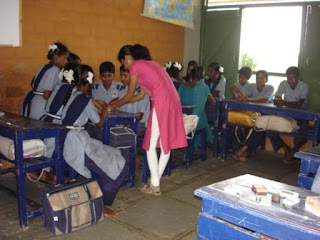

The kids have divided into their groups, and I give each a little box with some iron filings spread out. After a little introduction to magnets (with the help of a compass), I hand each group a bar magnet, and have them play with getting a field pattern in the filings.

When I go around and tap the box as it rests atop the magnet, the filings fall into place and the kids eyes widen. "Look, it's making a pattern!"


Now to explain the why, and how the field goes from north to south in all directions and how we can find what the field looks like by looking at the pattern in the filings.

And now a little induced magnetism to end the lesson. Iron piece = not magnetic. Iron piece + magnet = magnetic. Take off the magnet, and the filings fall off the iron piece again. It's like mag(net)ic!

Wednesday, July 21, 2010
Day 12 - Resistors and Circuits
We tried a lot of stuff yesterday, including making a lemon battery and changing the color of a color-changing LED we found. Today, we played around a little with circuits and resistors today in the 10th grade science class.

We basically took a resistance box and had the kids pull out keys (therefore adding resistance) and put them back to see the effect on the intensity of the light bulb. We had a color-changing LED as well, but that burnt out in the beginning of the second class (the 10th class is divided into two sections). At least everybody got to see it once.

The girls are sitting on their side of the classroom, waiting patiently, but...

ZOOM! As soon as it's their turn, they're up like they've been stung by fire ants. It's good to see that enthusiasm.

And enthusiasm is certainly not lacking here. A couple days ago, some of the students came up to us as we were talking to the headmaster and asked if we would teach an English class. My mom agreed to take a class from 8:30-9:30 (the hour before school) and 5:30-6:30 (the hour after school), so I'll help her out with that a little bit. The class will be both sections of 10th, and 50+ students is a tad difficult for one teacher.
The 10th graders want a little more help because they need to take their 10th class exams at the end of the year, and as much as they say they like English, it's not their strong suit. Who can blame them? The school is Telugu medium as of now (meaning all the classes are taught in the medium of Telugu), and they are one English teacher short of a full teaching staff.

We basically took a resistance box and had the kids pull out keys (therefore adding resistance) and put them back to see the effect on the intensity of the light bulb. We had a color-changing LED as well, but that burnt out in the beginning of the second class (the 10th class is divided into two sections). At least everybody got to see it once.

The girls are sitting on their side of the classroom, waiting patiently, but...
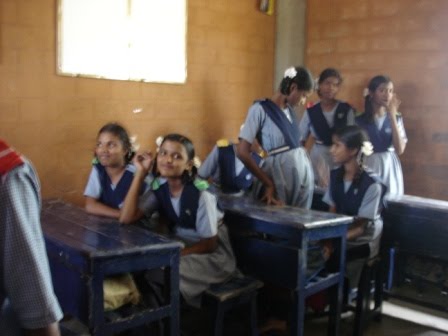
ZOOM! As soon as it's their turn, they're up like they've been stung by fire ants. It's good to see that enthusiasm.

And enthusiasm is certainly not lacking here. A couple days ago, some of the students came up to us as we were talking to the headmaster and asked if we would teach an English class. My mom agreed to take a class from 8:30-9:30 (the hour before school) and 5:30-6:30 (the hour after school), so I'll help her out with that a little bit. The class will be both sections of 10th, and 50+ students is a tad difficult for one teacher.
The 10th graders want a little more help because they need to take their 10th class exams at the end of the year, and as much as they say they like English, it's not their strong suit. Who can blame them? The school is Telugu medium as of now (meaning all the classes are taught in the medium of Telugu), and they are one English teacher short of a full teaching staff.
Storm
I look out my window and it looks like a storm is fast approaching. The farmers will certainly be happy, for their fields will finally get some water. Unfortunately, this means that the kids will not be here early tomorrow morning for the English class because they have to help their parents in the fields, but this is their livelihood, so it's okay. (Click any image for a high-res version).

The sky is absolutely stunning.
To the left, the clouds are white and the sky is bright. To the right, the dark mass of clouds moves in.

The sky is even darker now that we're in the thick of it. This is my absolute favorite picture of the lot.


The sky is absolutely stunning.

To the left, the clouds are white and the sky is bright. To the right, the dark mass of clouds moves in.

The sky is even darker now that we're in the thick of it. This is my absolute favorite picture of the lot.

Day 9 - Ascorbic Acid and Basketball
Since the kids came in yesterday, there is no school today, even though it's Monday. So we're spending the day testing some experiments. Electrolysis with soap bubbles catching the gases was a bit of a failure, but my mom has found some protocol for testing juices for how much vitamin C they have, and we've adapted it a little bit. Instead of starch, we're using ganji, the water left when cooking rice.

Even though it's a holiday, some of the kids have showed up. This is a small village, so for many, school really is their life. School is the center of all their activities. Today, they hang around our experiments for a little while, looking on as we try to get the starch/iodine test to work on an intact leaf (which, without boiling water, is a failure).Then some of the boys go off to play basketball in the dirt court of the courtyard, so I join them.


Even though it's a holiday, some of the kids have showed up. This is a small village, so for many, school really is their life. School is the center of all their activities. Today, they hang around our experiments for a little while, looking on as we try to get the starch/iodine test to work on an intact leaf (which, without boiling water, is a failure).Then some of the boys go off to play basketball in the dirt court of the courtyard, so I join them.


Wednesday, July 14, 2010
Day 8 - Baala Mela
Sunday is normally a holiday, but today is special. Vandita Rao, the CEO of the RDF, is bringing some visitors to the school. The students will be here, and some will have classes, but they will also be participating in cultural programs and the like, showing off all their skills. The days of the week don't matter as much here, so they will get tomorrow off instead.
The visitors arrive at about 9 in the morning, and assembly starts as usual at 9:30. Unlike everyday, however, the entire school squeezes into the courtyard as the primary school kids join the high schoolers in morning exercises, prayer, and the rest.

Today's joke is acted out by one of the teachers and a group of P.S. kids up on stage.

The students closest to us are the nursery (preschool) kids, who don't have uniforms. The red/green/yellow/blue patches on the students shoulders indicate the groups. The students wearing white here and there are the group leaders for their classes.

The visitors watch from the sidelines, and step onto the dais as they are asked one by one to come up and introduce themselves. Since some of them only speak English, the teachers pick an older student to try and translate. If that fails, the teachers themselves do the translation. For the rest of the time, Marena and Dan (foreground), Nick (by the pillar) and the other visitors whose names I don't know, just chill. Or bake, rather. It's pretty hot.

Upstairs, the high schoolers have created a mini planetarium with a flashlight and holes cut out of a deflated basketball (I can spot the Big Dipper just there!), a model of a solar eclipse, and various other astronomical phenomena. Pretty cool for a school.
The visitors arrive at about 9 in the morning, and assembly starts as usual at 9:30. Unlike everyday, however, the entire school squeezes into the courtyard as the primary school kids join the high schoolers in morning exercises, prayer, and the rest.

Today's joke is acted out by one of the teachers and a group of P.S. kids up on stage.
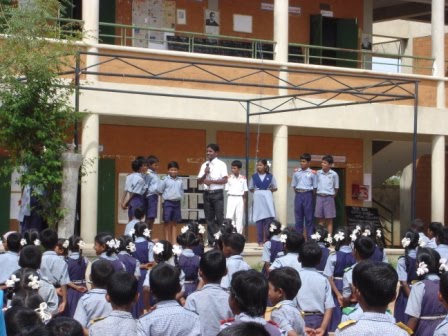
The students closest to us are the nursery (preschool) kids, who don't have uniforms. The red/green/yellow/blue patches on the students shoulders indicate the groups. The students wearing white here and there are the group leaders for their classes.

The visitors watch from the sidelines, and step onto the dais as they are asked one by one to come up and introduce themselves. Since some of them only speak English, the teachers pick an older student to try and translate. If that fails, the teachers themselves do the translation. For the rest of the time, Marena and Dan (foreground), Nick (by the pillar) and the other visitors whose names I don't know, just chill. Or bake, rather. It's pretty hot.

Upstairs, the high schoolers have created a mini planetarium with a flashlight and holes cut out of a deflated basketball (I can spot the Big Dipper just there!), a model of a solar eclipse, and various other astronomical phenomena. Pretty cool for a school.
Sunday, July 11, 2010
Listen
It's been quite nice living here in the science lab of an isolated village school. The air is fresh; the Hyderabadi smells of smog and pollution and human wastes are nowhere within noseshot. Unlike in the city, there are too few vehicles here to turn the air into the eye-stinging equivalent of a chlorinated swimming pool. A bus passes by 3 times a day in each direction, along with a few motorbikes and autos. Herds of goats and pairs of oxen pass by with about the same frequency as the non-organic moving things (though bicycles, mainly ridden by the students, are present in numbers).
The birds, too, are present in numbers. During the daytime, you can't go ten seconds without hearing some bird or other. In the mornings, the chorus is constantly present but varied in composition. The light, high chirping of tiny sparrow-like birds is sometimes overridden by the insistent, broken-record chirrup chirrup chirrup of a closer avian. Crows communicate their caww-cawws without regard for the gola (cacophony) they're making. The coooo-ooooh of the koyela (cuckoo) often pierces the morning air. And every now and then, if you listen carefully, you can hear the kreee-eeee of the peacock.
Birds aren't the only things that make sounds though. The ballilu (geckos, plural) here are quite vocal as well. Hiding behind the fluorescent lights or the tiles of the bathroom wall, they go chik-chik-chik-chik-chik about twice an hour. The flying insects buzz and hum their daily ditties each time they pass your ear. The big, friendly giant of the bug world, the thummeda (a 1.5 inch bumblebee) can flap its wings so quickly it can juyyyiii as loud as any bird call. The beetles that gather near the lights at nighttime make little tock noises every time they fly and crash into the walls or the ground (which ends up with them lying on their hard-shelled backs two times out of three; hence the sound).
And then, at about 8:30, the harmony of wildlife becomes a counterpoint to the melody of the (slightly) tamer life - the students.
The birds, too, are present in numbers. During the daytime, you can't go ten seconds without hearing some bird or other. In the mornings, the chorus is constantly present but varied in composition. The light, high chirping of tiny sparrow-like birds is sometimes overridden by the insistent, broken-record chirrup chirrup chirrup of a closer avian. Crows communicate their caww-cawws without regard for the gola (cacophony) they're making. The coooo-ooooh of the koyela (cuckoo) often pierces the morning air. And every now and then, if you listen carefully, you can hear the kreee-eeee of the peacock.
Birds aren't the only things that make sounds though. The ballilu (geckos, plural) here are quite vocal as well. Hiding behind the fluorescent lights or the tiles of the bathroom wall, they go chik-chik-chik-chik-chik about twice an hour. The flying insects buzz and hum their daily ditties each time they pass your ear. The big, friendly giant of the bug world, the thummeda (a 1.5 inch bumblebee) can flap its wings so quickly it can juyyyiii as loud as any bird call. The beetles that gather near the lights at nighttime make little tock noises every time they fly and crash into the walls or the ground (which ends up with them lying on their hard-shelled backs two times out of three; hence the sound).
And then, at about 8:30, the harmony of wildlife becomes a counterpoint to the melody of the (slightly) tamer life - the students.
Subscribe to:
Posts (Atom)