Showing posts with label school life. Show all posts

Wednesday, July 14, 2010

Day 8 - Baala Mela

Sunday is normally a holiday, but today is special. Vandita Rao, the CEO of the RDF, is bringing some visitors to the school. The students will be here, and some will have classes, but they will also be participating in cultural programs and the like, showing off all their skills. The days of the week don't matter as much here, so they will get tomorrow off instead.

The visitors arrive at about 9 in the morning, and assembly starts as usual at 9:30. Unlike everyday, however, the entire school squeezes into the courtyard as the primary school kids join the high schoolers in morning exercises, prayer, and the rest.


Today's joke is acted out by one of the teachers and a group of P.S. kids up on stage.
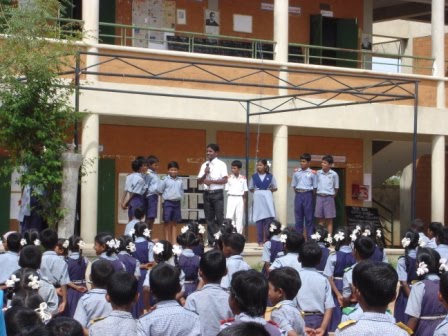

The students closest to us are the nursery (preschool) kids, who don't have uniforms. The red/green/yellow/blue patches on the students shoulders indicate the groups. The students wearing white here and there are the group leaders for their classes.


The visitors watch from the sidelines, and step onto the dais as they are asked one by one to come up and introduce themselves. Since some of them only speak English, the teachers pick an older student to try and translate. If that fails, the teachers themselves do the translation. For the rest of the time, Marena and Dan (foreground), Nick (by the pillar) and the other visitors whose names I don't know, just chill. Or bake, rather. It's pretty hot.


Upstairs, the high schoolers have created a mini planetarium with a flashlight and holes cut out of a deflated basketball (I can spot the Big Dipper just there!), a model of a solar eclipse, and various other astronomical phenomena. Pretty cool for a school.

Wednesday, July 7, 2010

The RDF School Matendla

Matendla Rural School is run by the Rural Development Foundation. The students are given a midday meal and their uniforms and school books are paid for by the RDF. The teachers are all local which means they are more invested in the students' learning and more motivated to actually be at school and teach every day. The students, in turn, are invested in the community. Many of them go home after school and help their parents in the fields or in taking care of the little ones.

Last year, the teachers, parents, and students together took some initiative in the village. The teachers began by stopping their alcohol and cigarette intake as completely as possible. Then they talked to the Village Committee and got the council leaders to stop as well. All told, they got at least 30 parents to stop smoking and drinking.

Another project the school stared relatively recently was that of a kids' bank. The students themselves take on the roles involved, and a teacher checks the numbers afterward. It helps the children learn how to use the banking system - and gets them interested in saving money.

Really, the students are involved in everything from their own learning (the Question Bank questions) to the running of the school. They have to participate in at least one extracurricular activity, and sports are highly encouraged. At least within Medak district, many top student athletes are from Matendla.


I played with them. They're not bad at basketball either despite the fact that their hoop has no special backboard and their court is a dirt courtyard.

Monday, July 5, 2010

Day 2 - Assembly

It's Monday morning, and we're up by 7 because we're supposed to have breakfast at 8. School starts at 9:30, but some of the students start showing up around 8:30. These are mainly the ones in charge of things like checking the library, cleaning their classroom, or writing the news on the big blackboards set against the walls outside (this particular one is actually for a "classroom" on the veranda).


At 9:30, the bell rings and the high school students gather in the courtyard for assembly. Nick, my mother, and I are called up to the stage to introduce ourselves and say what we'll be doing. The students, meanwhile, stand in front of us in long columns, one per class (grade). As usual in an Indian school, they begin with morning exercises, followed by Vande Mataram and Maa Telugu Thalliki (patriotic songs for the country and the state, respectively). On other days, they recite a prayer to Saraswathi, the goddess of education, or sing Saare Jahan Se Achcha. I'm cheating a little bit with this picture because it's actually from the next Sunday when the primary school kids joined the older students, but it'll give you an idea of what it's like.


A couple of students on stage read out the news, while those in the columns listen and then raise their hands to answer some related quiz questions. Next comes the Question Bank question, a "why?" or "how?" wondered at by a student, written down, and placed in a box near the library. Each day, the question is asked, and if none of the students know its explanation, the teachers provide the answer. Out of the questions in the box from Saturday, the teachers picked this (translated): "If we can't see or touch air, how did we ever find out what it's composed of?"

When we are done here, we are taken to the other side of the building to introduce ourselves at the end of the primary school assembly. Here, the stage is made of raised earth, and the Nursery (think preschool) through 5th graders are lined up in their own columns, standing remarkably (though of course not completely) still. I've yet to see that many five-year-olds with that much self-control anywhere in America. At the end, around 10 am, the students march off to class to the cadence of a snare drum and a very small bass drum. Left, right, left, right, though the student in front of you may be going right, left, right, left...