Today is our last day here. And apparently there's a bandh going on. Ummm...I really hope that doesn't mean school is canceled and we don't get to do all our experiments. If the TRS (Telangana Rasthra Samithi), the party agitating for a separate Telangana, gets to the school before first period, it might be. Once school starts, though, the principal won't stop it again.
He has a good argument for the TRS too. Once the cooks start making lunch, it would be a huge waste of money and food to get rid of all they've cooked. And the TRS people around here seem to understand that the RDF is serious about teaching the kids, and that interrupting school is not the best way to advance Telangana's interests.
Just in case, though, we decide to teach the 6th graders first. They've been asking for us to come to their class for days, and we haven't yet done any experiments with them. It screws up the schedule a bit, but we really want to work with them.
I do the same magnetism spiel from two days ago, but simplify. I emphasize the attraction/repulsion a bit more since they haven't really learned it yet. I have each person in the group try to push like poles of the bar magnets together, and they giggle with glee as each successive person fails to touch the two ends. "Arey, adey kaduluthondi!" (Hey, it's moving by itself!)
My mom was planning to just show them electroplating, but she ends up doing it the same way she did it with the other classes, by assigning each student in the group to hold a wire or a coin, or to observe the coin and tell us when it has turned red enough to break the circuit. It gets them more involved, and they feel like science is something they can do, so that's okay.
For 4th period, we do both sections of 9th. We call them over to the lab and demonstrate the iodine clock. I pour everything in and tell them it's the pindi padhartham (iodine-starch test). Then I ask, why isn't it changing colors? About 20 seconds later, I draw their attention back to the tube, and they gasp as it suddenly begins to change to a dark blue. Now it's time to give a cut-down explanation of what's happening in the tube.
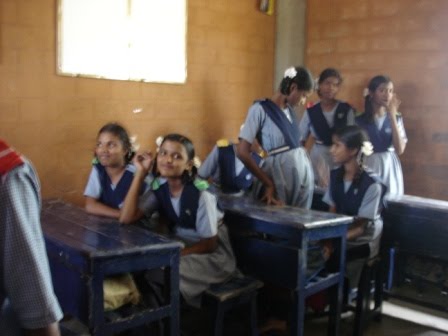
Afterwards, we give them a little demo of litmus paper as well, then eat lunch and carry all our solutions back up for the 7th graders. These kids are much more rowdy than the 6th graders. The teacher has brought all of them out here, and since we can only take half the class at any time, the other two groups are sitting by the wall in front of us. But they're so close, and they can't resist getting up and peering over the other kids' shoulders. No matter how many times we tell them they'll get their turn next, they keep sneaking up to look at the magnets and the litmus paper.
A couple of them even manage to knock over the (dilute) sodium hydroxide solution. Oops. Well, there's still a little left in the glass, but they have to be careful not to touch the tablecloth for now. Luckily, a later group knocks over the acid, so the tablecloth is neutralized and deemed safe once again.
By the time the last group comes up, they already know half of what I'm going to tell them because they've caught glimpses during each of the other 3 groups' turns before we chased them away again. It's okay, though, because it shows how interested they are. If I were a normal teacher and this were an everyday occurrence, it wouldn't work, but we're only here until this evening, so it's okay. At least they're paying close attention (and helping to clean up the iron filings they've spilled all over the place).
Okay kids, it's been fun, but we have to go know. Keep that curiosity burning! You guys are great.
Showing posts with label science. Show all posts
Friday, August 27, 2010
Thursday, August 26, 2010
Day 29 - Confusion
Today is Sunday. On Saturday morning, we were told that there would be school today because Vandita madam (the CEO) was bringing up some visitors. When that happens, there tends to be some sort of exhibition at school on Sunday and Monday becomes a holiday. They try not to rearrange the schedule too often, but they do it from time to time. On this particular day, Vandita madam's visitors could not make it that day, and school was canceled. This was known by Saturday afternoon.
Unfortunately, nobody realized we had been told there would be school, so nobody realized they would have to tell us there wouldn't be school. So we wake up and get ready for breakfast by 8 as usual, to find the place deserted.
Ah well. We have the key to the science lab. Might as well use today to test out some experiments.
As we stroll through the school gate, our eyes fall upon kids playing in the volleyball court and the area near the science lab. We ask, why are you here on a Sunday?
They answer, we're here to use the library and the computer lab. They open at 10, but we're here (an hour) early.
Okay, we say, that's good. And we go in to the science lab to work on some experiments. My mom is playing with some of the lenses, utilizing the contrast of the dark inside with the bright light from outdoors to make pretty pictures. I once again attempt the iodine clock reaction.This time, I use only the tiniest pinch of KI and a slightly larger pinch of Na2S2O3. The H2O2 seems to be rather dilute, so I use a lot more of it than I did before. And this time, I find a funnel so I can add everything at the same time.
Here, we turn around and find a gaggle of kids at the windows and doors, watching us dole out small measures of chemicals into various test tubes. Everyone that was waiting outside is now waiting by our window. Most of them say they're 6th/7th graders, which makes sense, since we haven't done many experiments with them yet, and they've been asking when we'll come to their class. Tomorrow, little darlings. Tomorrow is your day.
They skip off, not because we've told them we'll be working with them tomorrow, but because the teacher has just opened the door of the computer lab and is working on the lock for the library. So I turn back to my iodine clock and toss everything down the funnel at once.
Lo and behold, it works! Since I have no balance (there is a very good two-pan balance, but it's locked away in a glass cabinet, and looks like a treasured possession rather than a usable scale), I can't really calculate and set the clock for a certain amount of time. Still, I've got it working within about 20-40 seconds, which is perfect. By afternoon, my mom's found some litmus paper and made some dilute acid/base solutions, so everything's set for tomorrow. Time to relax a little.
Unfortunately, nobody realized we had been told there would be school, so nobody realized they would have to tell us there wouldn't be school. So we wake up and get ready for breakfast by 8 as usual, to find the place deserted.
Ah well. We have the key to the science lab. Might as well use today to test out some experiments.
As we stroll through the school gate, our eyes fall upon kids playing in the volleyball court and the area near the science lab. We ask, why are you here on a Sunday?
They answer, we're here to use the library and the computer lab. They open at 10, but we're here (an hour) early.
Okay, we say, that's good. And we go in to the science lab to work on some experiments. My mom is playing with some of the lenses, utilizing the contrast of the dark inside with the bright light from outdoors to make pretty pictures. I once again attempt the iodine clock reaction.This time, I use only the tiniest pinch of KI and a slightly larger pinch of Na2S2O3. The H2O2 seems to be rather dilute, so I use a lot more of it than I did before. And this time, I find a funnel so I can add everything at the same time.
Here, we turn around and find a gaggle of kids at the windows and doors, watching us dole out small measures of chemicals into various test tubes. Everyone that was waiting outside is now waiting by our window. Most of them say they're 6th/7th graders, which makes sense, since we haven't done many experiments with them yet, and they've been asking when we'll come to their class. Tomorrow, little darlings. Tomorrow is your day.
They skip off, not because we've told them we'll be working with them tomorrow, but because the teacher has just opened the door of the computer lab and is working on the lock for the library. So I turn back to my iodine clock and toss everything down the funnel at once.
Lo and behold, it works! Since I have no balance (there is a very good two-pan balance, but it's locked away in a glass cabinet, and looks like a treasured possession rather than a usable scale), I can't really calculate and set the clock for a certain amount of time. Still, I've got it working within about 20-40 seconds, which is perfect. By afternoon, my mom's found some litmus paper and made some dilute acid/base solutions, so everything's set for tomorrow. Time to relax a little.
Wednesday, August 18, 2010
Day 28 - DNA, Electroplating, and Magnets, Oh My!
Today, we have scheduled a simple DNA extraction demonstration for the two sections of 10th class. There have been a few changes since I tried this in Matendla. Instead of onion, we're using a banana. The two reasons for this are as follows:
Afterward, we take electroplating to the 8th graders, and to keep more of them occupied at any given time, we do magnetism as well. The 8th grade classes are located at one end of the second-floor labyrinth, and we would definitely not have found them were it not for our student guides/helpers who carried the materials all the way over.
There are two tables set up on the balcony outside, and we decide to take advantage of that. My mom sets up the electroplating materials on the right table, and I set up my magnets and iron filings on the left. This way, we can do two groups at once, keeping half of the 30-member class occupied at a time.
I begin by ascertaining how much they know about magnets. Opposite poles attract, like poles repel. A compass points north. They've got all that, but I figure it's useful to have a quick refresher, since lessons on science topics are so ridiculously spread out across the years in the curriculum.
So I move on the magnetic field, which I know they haven't yet covered. They don't need to know it yet, but it's a memorable demo. Place a magnetic field under a piece of cardboard (in this case, the lid of a box) containing iron filings (these are actually shavings taken from some iron/steel mill - I've sifted out the big, sharp pieces and kept only the fine iron dust). Nothing really happens. Give the box a few taps, and all of a sudden, the iron filings align themselves along the field lines, revealing a pattern.
Next up is induced magnetism, in which a non-magnetic piece of iron becomes a magnet itself when it is stuck to one end of the bar magnet. As soon as you pull the magnet off, the iron filings fall. The kids seem to enjoy playing with this one, and I sometimes have to take back the magnets and redistribute them so everyone in the group gets a chance to try.
After giving this spiel on magnetism 8 times, I think I've got it down pretty well. But my throat is getting tired of the constant talking. Time for some water and some rest before we head over to the junior college for dinner.
- The inside of a banana is pretty sterile. You don't really have to worry about dirt and things that will break up your DNA into pieces too short to spool.
- It's much much easier to mash a banana inside a ziploc bag than to find a mortar and pestle (a.k.a. a roll, which is used in cooking in India) and grind an onion with soap solution. Especially when the science lab is isolated from the rest of the school and you have no idea where all the teachers are because you're testing it out after school.
Afterward, we take electroplating to the 8th graders, and to keep more of them occupied at any given time, we do magnetism as well. The 8th grade classes are located at one end of the second-floor labyrinth, and we would definitely not have found them were it not for our student guides/helpers who carried the materials all the way over.
There are two tables set up on the balcony outside, and we decide to take advantage of that. My mom sets up the electroplating materials on the right table, and I set up my magnets and iron filings on the left. This way, we can do two groups at once, keeping half of the 30-member class occupied at a time.
I begin by ascertaining how much they know about magnets. Opposite poles attract, like poles repel. A compass points north. They've got all that, but I figure it's useful to have a quick refresher, since lessons on science topics are so ridiculously spread out across the years in the curriculum.
So I move on the magnetic field, which I know they haven't yet covered. They don't need to know it yet, but it's a memorable demo. Place a magnetic field under a piece of cardboard (in this case, the lid of a box) containing iron filings (these are actually shavings taken from some iron/steel mill - I've sifted out the big, sharp pieces and kept only the fine iron dust). Nothing really happens. Give the box a few taps, and all of a sudden, the iron filings align themselves along the field lines, revealing a pattern.
Next up is induced magnetism, in which a non-magnetic piece of iron becomes a magnet itself when it is stuck to one end of the bar magnet. As soon as you pull the magnet off, the iron filings fall. The kids seem to enjoy playing with this one, and I sometimes have to take back the magnets and redistribute them so everyone in the group gets a chance to try.
After giving this spiel on magnetism 8 times, I think I've got it down pretty well. But my throat is getting tired of the constant talking. Time for some water and some rest before we head over to the junior college for dinner.
Wednesday, August 11, 2010
Day 27 - Gotta Follow the Procedure...or Change Your Plans
Plant pigment chromatography worked so beautifully in Matendla. Well, it's not working here. To be fair, we don't have enough time in the morning to prepare before class, so we can't get tamalapaku leaves crushed with ethanol by a mortar and pestle. Instead, my mom tries to crush some badam (almond) leaves by hand. Yeah, that doesn't really get the chlorophyll out.
The experiment worked well in Matendla because we did a quick demo, then had the students get into (four large) groups and do it themselves. They got to play with it and do something with their hands, and they had lots of questions afterward.
Here, we can't find enough beakers, so the class has to sit for 20 minutes, watching the acetone slowly creep up the filter paper from 20 feet away while we try to explain the principles behind an experiment that is not showing the result it's supposed to.
We've learned our lesson. Instead of taking the second section of 10th class immediately afterward, we ask if we could have one period extra to prepare. Hurrying back to the lab, we make a change of plans. Who needs plant pigments? That would relate much better to bio, but these kids have never even seen paper chromatography. So we borrow some markers.
A quick test shows us that mixing red, green, and blue markers in a line along the bottom of the filter paper strip results in a very nice separation. We hunt through the cabinets one more time and find a couple of glasses to go along with the beakers. A poor washrag that has the misfortune of being nearby gets torn into 5 pieces to act as a cover for the beakers. We pick a couple of solvent systems and get some students to help us carry all the equipment back across the grounds and up the stairs to the school.
The second section of 10th gets a much better lesson. We call groups of 6 kids outside one group at a time, and demonstrate what they need to do. Then we hand them the scissors, filter paper, markers, tape, and beaker with solvent system (water, acetone + water, or ethanol + water), and send them off to a corner of the balcony to begin their test.
As we check the groups, we find that for some, the green color has disappeared and yellow has appeared! So in the spirit of science, we assign those groups a second task now that their first chromatograph has finished: try it again with just the green.
After everyone's marker pigments have separated out clearly enough, we return to the classroom to talk about the principles. We draw a little color-chalk diagram of each group's results on the board and compare them. We ask everyone, where did the yellow come from? And then we suggest that perhaps the green marker was actually made up of yellow and blue, and show the extra chromatograph to prove that this is indeed the case.
All in all, it's a pretty successful lesson. But the first section of 10th didn't get it. So we go back to their classroom after lunch (the teachers are very accommodating since this is a short-term project) and repeat the better version of paper chromatography with them.
Perhaps it's because we gave them freedom to work in groups, or perhaps because the experiment is really working, or simply because the teacher is not sitting at the back watching them, but the kids are much more enthusiastic this time around. One group even carries out a little experiment of their own: they try it with regular notebook paper.
Obviously it doesn't work, but they ask why in the discussion afterward, and we're able to explain about the qualities of filter paper that make capillary action work much better. But they're thinking about it themselves and trying things, and that was really the goal of this whole exercise. Science is not something you just learn and memorize from a textbook. Science is something you do, and think about, and keep on doing.
The experiment worked well in Matendla because we did a quick demo, then had the students get into (four large) groups and do it themselves. They got to play with it and do something with their hands, and they had lots of questions afterward.
Here, we can't find enough beakers, so the class has to sit for 20 minutes, watching the acetone slowly creep up the filter paper from 20 feet away while we try to explain the principles behind an experiment that is not showing the result it's supposed to.
We've learned our lesson. Instead of taking the second section of 10th class immediately afterward, we ask if we could have one period extra to prepare. Hurrying back to the lab, we make a change of plans. Who needs plant pigments? That would relate much better to bio, but these kids have never even seen paper chromatography. So we borrow some markers.
A quick test shows us that mixing red, green, and blue markers in a line along the bottom of the filter paper strip results in a very nice separation. We hunt through the cabinets one more time and find a couple of glasses to go along with the beakers. A poor washrag that has the misfortune of being nearby gets torn into 5 pieces to act as a cover for the beakers. We pick a couple of solvent systems and get some students to help us carry all the equipment back across the grounds and up the stairs to the school.
The second section of 10th gets a much better lesson. We call groups of 6 kids outside one group at a time, and demonstrate what they need to do. Then we hand them the scissors, filter paper, markers, tape, and beaker with solvent system (water, acetone + water, or ethanol + water), and send them off to a corner of the balcony to begin their test.
As we check the groups, we find that for some, the green color has disappeared and yellow has appeared! So in the spirit of science, we assign those groups a second task now that their first chromatograph has finished: try it again with just the green.
After everyone's marker pigments have separated out clearly enough, we return to the classroom to talk about the principles. We draw a little color-chalk diagram of each group's results on the board and compare them. We ask everyone, where did the yellow come from? And then we suggest that perhaps the green marker was actually made up of yellow and blue, and show the extra chromatograph to prove that this is indeed the case.
All in all, it's a pretty successful lesson. But the first section of 10th didn't get it. So we go back to their classroom after lunch (the teachers are very accommodating since this is a short-term project) and repeat the better version of paper chromatography with them.
Perhaps it's because we gave them freedom to work in groups, or perhaps because the experiment is really working, or simply because the teacher is not sitting at the back watching them, but the kids are much more enthusiastic this time around. One group even carries out a little experiment of their own: they try it with regular notebook paper.
Obviously it doesn't work, but they ask why in the discussion afterward, and we're able to explain about the qualities of filter paper that make capillary action work much better. But they're thinking about it themselves and trying things, and that was really the goal of this whole exercise. Science is not something you just learn and memorize from a textbook. Science is something you do, and think about, and keep on doing.
Sunday, August 8, 2010
Day 26 - Electroplating
Today is filled with electroplating. We're doing it for the 10th graders first, then 9th, and even 7th. Since we aren't explaining things in detail to the 7th graders, we're doing both sections (meaning about 60 kids) at once.
We call up the kids in groups so they can see the plating up close. We have them hold the coins and connect the wires as much as possible so they feel like they're actually doing something. As the one-rupee coin turns red, they laughed in astonishment. And then we switch the poles, and like magic (or chemistry), the color disappears.
Calling up 60 students in groups takes time, though, and by the time we finish, we're halfway into their break. Fortunately, the morning's rain has slowed the preparation of lunch, and break has technically not yet begun. Still, the younger kids in other classes are done, and they've begun gathering at the door.
We literally have to chase them away because they're distracting the students we're trying to teach right now.
"Go play," we tell them. "We'll come to your class too."
And still they hang around. A few days later, when we visit the 6th grade class with our copper plate and beaker of CuSO4, one of the kids excitedly tells the others, "Adi erraga avuthadi!" (It's going to turn red!)
We ask him, how do you know that? And he replies that when we were showing this to the 7th graders, he was listening through the window. Even after we shooed them away.
You've got to give these kids props for how much they want to learn.
We call up the kids in groups so they can see the plating up close. We have them hold the coins and connect the wires as much as possible so they feel like they're actually doing something. As the one-rupee coin turns red, they laughed in astonishment. And then we switch the poles, and like magic (or chemistry), the color disappears.
Calling up 60 students in groups takes time, though, and by the time we finish, we're halfway into their break. Fortunately, the morning's rain has slowed the preparation of lunch, and break has technically not yet begun. Still, the younger kids in other classes are done, and they've begun gathering at the door.
We literally have to chase them away because they're distracting the students we're trying to teach right now.
"Go play," we tell them. "We'll come to your class too."
And still they hang around. A few days later, when we visit the 6th grade class with our copper plate and beaker of CuSO4, one of the kids excitedly tells the others, "Adi erraga avuthadi!" (It's going to turn red!)
We ask him, how do you know that? And he replies that when we were showing this to the 7th graders, he was listening through the window. Even after we shooed them away.
You've got to give these kids props for how much they want to learn.
Thursday, August 5, 2010
Day 25 - Still Experimenting
So the science teachers have taken all of the science equipment out of the cabinets and spread it out on the tables so we can easily see what they've got. We looked through it a bit yesterday, and the thing is, while they have a lot of cool stuff, they don't have some of the basics.
There's one two-pan balance, but it looks like it's never been used.
There's no sink in the lab.
No beakers smaller than 250 mL.
At least they have pipet bulbs that fit the droppers, unlike in Matendla.
They do have a small book of simple science experiments plus a kit of materials to show concepts like surface tension, the Bernoulli principle, sound waves, etc. Apparently the science teachers all attended a little training on how to do these experiments with the students. Well, hopefully this can be shared with the Matendla teachers if they come to visit.
Today, we're doing some circuits stuff with the 10th graders. We've found some little lights in the cupboard, like Christmas lights but smaller. The great thing is, these lights work with very little voltage/current, and we can easily string them up in series, because, well, they're already in series.
After lunch, we try out electroplating because they have some nice big copper plates for electrodes, instead of just pieces of copper wire. As soon as we add copper sulfate to the water, it turns a cloudy blue, and a white precipitate begins to form.
Uhhh...that's not supposed to happen...
Adding a little H2SO4 returns the solution to its normal clear blue. I have no idea what's in the water, but it can't be good for the kids to drink.
There's one two-pan balance, but it looks like it's never been used.
There's no sink in the lab.
No beakers smaller than 250 mL.
At least they have pipet bulbs that fit the droppers, unlike in Matendla.
They do have a small book of simple science experiments plus a kit of materials to show concepts like surface tension, the Bernoulli principle, sound waves, etc. Apparently the science teachers all attended a little training on how to do these experiments with the students. Well, hopefully this can be shared with the Matendla teachers if they come to visit.
Today, we're doing some circuits stuff with the 10th graders. We've found some little lights in the cupboard, like Christmas lights but smaller. The great thing is, these lights work with very little voltage/current, and we can easily string them up in series, because, well, they're already in series.
After lunch, we try out electroplating because they have some nice big copper plates for electrodes, instead of just pieces of copper wire. As soon as we add copper sulfate to the water, it turns a cloudy blue, and a white precipitate begins to form.
Uhhh...that's not supposed to happen...
Adding a little H2SO4 returns the solution to its normal clear blue. I have no idea what's in the water, but it can't be good for the kids to drink.
Wednesday, July 28, 2010
Day 21 - The Last of the First
Today is my last full day at Matendla. We're going to do a couple labs, take care of the English classes, and say bye to the kids. Tomorrow morning, we'll catch the bus to Siddipet and then another bus from there to Jubilee Hills in Hyderabad, from where we will have to take an auto to get home.
We start in the morning with the 10th graders, doing that Bullseye lab (for projectile motion) that we did in Mr. Robinson's class in high school. Unfortunately, without a smooth, relatively frictionless ramp, the calculations don't quite work out. We turn it into a lesson on how science doesn't work a lot of the time, and how you can work backward from what you find to figure out why it didn't work. Well, at least the kids had fun playing with marbles.
The 8th graders have their turn with surface tension next. We only have a limited number of boats, so we pick popsicle sticks with their names. Some boats move successfully, while others don't. Perhaps a slightly less concentrated soap solution would work better next time.
Not everyone gets to try a boat, but still, they look pretty happy when the boats actually move. If nothing else, they're excited about the camera :D
After school is the last English class. The kids have been falling over Curious George, The Beauty and the Beast, Thumbelina, and Mickey and Friends like piranhas. As soon as the lesson is over and it's time for reading, there is a veritable riot as they scramble for the 15-20 books we have. There still aren't enough, so they read in groups. They're asking fewer questions of us, which I hope means they're understanding more words, but I still see some writing down words they don't know to look up later. That's the best way to do it!
We start in the morning with the 10th graders, doing that Bullseye lab (for projectile motion) that we did in Mr. Robinson's class in high school. Unfortunately, without a smooth, relatively frictionless ramp, the calculations don't quite work out. We turn it into a lesson on how science doesn't work a lot of the time, and how you can work backward from what you find to figure out why it didn't work. Well, at least the kids had fun playing with marbles.
The 8th graders have their turn with surface tension next. We only have a limited number of boats, so we pick popsicle sticks with their names. Some boats move successfully, while others don't. Perhaps a slightly less concentrated soap solution would work better next time.
Not everyone gets to try a boat, but still, they look pretty happy when the boats actually move. If nothing else, they're excited about the camera :D
After school is the last English class. The kids have been falling over Curious George, The Beauty and the Beast, Thumbelina, and Mickey and Friends like piranhas. As soon as the lesson is over and it's time for reading, there is a veritable riot as they scramble for the 15-20 books we have. There still aren't enough, so they read in groups. They're asking fewer questions of us, which I hope means they're understanding more words, but I still see some writing down words they don't know to look up later. That's the best way to do it!
Thursday, July 22, 2010
Day 13 - Magnets
It's really difficult to make the iodine clock reaction work when you have no balances and therefore no idea what the molarity of your solutions really are. Magnets, on the other hand, work perfectly well without balances. Nik found some magnets and a little packet of iron filings before he left on Sunday, so we're going to do magnetism for the 8th and 9th graders since it's in their curriculum (though all the pictures here are of 8th).
The kids have divided into their groups, and I give each a little box with some iron filings spread out. After a little introduction to magnets (with the help of a compass), I hand each group a bar magnet, and have them play with getting a field pattern in the filings.
When I go around and tap the box as it rests atop the magnet, the filings fall into place and the kids eyes widen. "Look, it's making a pattern!"
Now to explain the why, and how the field goes from north to south in all directions and how we can find what the field looks like by looking at the pattern in the filings.
And now a little induced magnetism to end the lesson. Iron piece = not magnetic. Iron piece + magnet = magnetic. Take off the magnet, and the filings fall off the iron piece again. It's like mag(net)ic!
The kids have divided into their groups, and I give each a little box with some iron filings spread out. After a little introduction to magnets (with the help of a compass), I hand each group a bar magnet, and have them play with getting a field pattern in the filings.
When I go around and tap the box as it rests atop the magnet, the filings fall into place and the kids eyes widen. "Look, it's making a pattern!"
Now to explain the why, and how the field goes from north to south in all directions and how we can find what the field looks like by looking at the pattern in the filings.
And now a little induced magnetism to end the lesson. Iron piece = not magnetic. Iron piece + magnet = magnetic. Take off the magnet, and the filings fall off the iron piece again. It's like mag(net)ic!
Wednesday, July 21, 2010
Day 12 - Resistors and Circuits
We tried a lot of stuff yesterday, including making a lemon battery and changing the color of a color-changing LED we found. Today, we played around a little with circuits and resistors today in the 10th grade science class.
We basically took a resistance box and had the kids pull out keys (therefore adding resistance) and put them back to see the effect on the intensity of the light bulb. We had a color-changing LED as well, but that burnt out in the beginning of the second class (the 10th class is divided into two sections). At least everybody got to see it once.
The girls are sitting on their side of the classroom, waiting patiently, but...
ZOOM! As soon as it's their turn, they're up like they've been stung by fire ants. It's good to see that enthusiasm.
And enthusiasm is certainly not lacking here. A couple days ago, some of the students came up to us as we were talking to the headmaster and asked if we would teach an English class. My mom agreed to take a class from 8:30-9:30 (the hour before school) and 5:30-6:30 (the hour after school), so I'll help her out with that a little bit. The class will be both sections of 10th, and 50+ students is a tad difficult for one teacher.
The 10th graders want a little more help because they need to take their 10th class exams at the end of the year, and as much as they say they like English, it's not their strong suit. Who can blame them? The school is Telugu medium as of now (meaning all the classes are taught in the medium of Telugu), and they are one English teacher short of a full teaching staff.
We basically took a resistance box and had the kids pull out keys (therefore adding resistance) and put them back to see the effect on the intensity of the light bulb. We had a color-changing LED as well, but that burnt out in the beginning of the second class (the 10th class is divided into two sections). At least everybody got to see it once.
The girls are sitting on their side of the classroom, waiting patiently, but...
ZOOM! As soon as it's their turn, they're up like they've been stung by fire ants. It's good to see that enthusiasm.
And enthusiasm is certainly not lacking here. A couple days ago, some of the students came up to us as we were talking to the headmaster and asked if we would teach an English class. My mom agreed to take a class from 8:30-9:30 (the hour before school) and 5:30-6:30 (the hour after school), so I'll help her out with that a little bit. The class will be both sections of 10th, and 50+ students is a tad difficult for one teacher.
The 10th graders want a little more help because they need to take their 10th class exams at the end of the year, and as much as they say they like English, it's not their strong suit. Who can blame them? The school is Telugu medium as of now (meaning all the classes are taught in the medium of Telugu), and they are one English teacher short of a full teaching staff.
Friday, July 9, 2010
Day 6 - Back on Track
Okay, back to science! I'm doing a couple of little surface tension experiments with the 9th graders today. The first one is a simple demonstration. Fill a glass with water all the way to the top, and then gently drop in marbles until the water level is above the edge of the glass. What's holding the water in that dome shape and keeping it from falling over the edge is surface tension.
The second one is more fun for the kids. We've got a little tray with about an inch of water, and a small fleet of cardboard boats (which are really just pentagons with a little rectangle cut out of the back). A drop of soap in that cut-out slit propels them forward. Zoom!
We only have about 10 boats for 25 kids, so we pick them randomly. They've got a little box filled with wooden ice cream spoons (like popsicle sticks) with their names on them, and we draw out one at a time. Some of them miss the slot and then the boat can no longer move because the surface tension is equally decreased on all sides of the boat. We explain why you only get one chance, and they seem to understand.
Srinivas, one of the computer teachers, comes in a little late to observe. He's young - he's 19 and still doing his Bachelors degree - and enthusiastic. So when one of the students misses the slot, he tries adding more soap, and the kids laugh and tell him it won't work because the soap has dispersed through the water. It looks like they really do understand. Cool.
The second one is more fun for the kids. We've got a little tray with about an inch of water, and a small fleet of cardboard boats (which are really just pentagons with a little rectangle cut out of the back). A drop of soap in that cut-out slit propels them forward. Zoom!
We only have about 10 boats for 25 kids, so we pick them randomly. They've got a little box filled with wooden ice cream spoons (like popsicle sticks) with their names on them, and we draw out one at a time. Some of them miss the slot and then the boat can no longer move because the surface tension is equally decreased on all sides of the boat. We explain why you only get one chance, and they seem to understand.
Srinivas, one of the computer teachers, comes in a little late to observe. He's young - he's 19 and still doing his Bachelors degree - and enthusiastic. So when one of the students misses the slot, he tries adding more soap, and the kids laugh and tell him it won't work because the soap has dispersed through the water. It looks like they really do understand. Cool.
Thursday, July 8, 2010
Days 4 and 5 - No Science
So the science has died down a bit. I've been trying to get the DNA extraction to work, but it refuses to. I can see a white precipitate between the detergent/onion extraction mixture and the alcohol layer, but the pieces are too broken up to pick up. It could just be the general lack of a sterile atmosphere, but I think that having ice-cold ethanol (as the procedures dictate) would probably help. Ice, however, would probably have to be brought 30 km from Siddipet. I'm not going to make them bring ice when I don't even know whether that's really the reason it's not working.
This is probably the reason that most science nowadays is done in rich countries. Science in general doesn't work. The thing is, though, failure is almost the point, because you learn what is not true, but when your materials and time are limited, it can be frustrating. Seriously, science is something like 98% failure, 1% success, and 1% unexpected results. If you don't have the money to keep buying materials to keep trying, you can't really do it no matter how good your experimental design skills are.
At any rate, I've also been helping Nick come up with ideas for helping the teachers improve their English. We're making a lesson plan for them to follow for the next month. For my practice, I'm doing my hours. 4 hours a day times 30 days is the minimum 120 hours. I'm spending close to that much on the science stuff, trying out experiments, doing them with the classes, and talking to the teachers afterward. Plus there's all the hours I spent in researching experiments and how to teach science and alternate protocols with simpler materials (and writing up the lessons to go with the labs) even before I came to India. So I think I'm okay on that count.
Last but not least, I will have to respectfully disagree with Charles Schultz. Happiness is not a warm puppy. Happiness is ice-cold water.
This is probably the reason that most science nowadays is done in rich countries. Science in general doesn't work. The thing is, though, failure is almost the point, because you learn what is not true, but when your materials and time are limited, it can be frustrating. Seriously, science is something like 98% failure, 1% success, and 1% unexpected results. If you don't have the money to keep buying materials to keep trying, you can't really do it no matter how good your experimental design skills are.
At any rate, I've also been helping Nick come up with ideas for helping the teachers improve their English. We're making a lesson plan for them to follow for the next month. For my practice, I'm doing my hours. 4 hours a day times 30 days is the minimum 120 hours. I'm spending close to that much on the science stuff, trying out experiments, doing them with the classes, and talking to the teachers afterward. Plus there's all the hours I spent in researching experiments and how to teach science and alternate protocols with simpler materials (and writing up the lessons to go with the labs) even before I came to India. So I think I'm okay on that count.
Last but not least, I will have to respectfully disagree with Charles Schultz. Happiness is not a warm puppy. Happiness is ice-cold water.
Tuesday, July 6, 2010
Day 3 - Science At Last!
Yes! Today I get to actually do some experiments! I'm starting with the one I know will work - the plant pigment chromatography based off what we did in AP Bio. I don't have ether, but Elizabeth bought us a bottle of acetone, which works fine.
I'm doing this with the entire 10th class at once during 4th period (just before lunch). They're usually divided into two sections, but I've got about 50 students here. I've been informed that the little red/green/yellow/blue patches on their shoulders are used for dividing them into groups, so we use them. The students sit either in circles on the floor or gathered around a couple of benches (desks), curious to see what's in the dark bottles I've brought with me.
I explain what the teachers have done so far - extracting the pigments from some leaves using a roll (mortar and pestle) and surgical spirit (which I think is isopropanol, since that's what it smells like) - and tell them what they will be doing. We cut filter paper into strips, mark the loading line with a pencil, and hand one piece to each group. I demo the experiment once, making sure that all of the windows are open so we don't breathe too much of those lovely acetone fumes, and then have them do it.
The solid green line travels up the filter paper, splitting (though not separating as much as I would like) into 3 visible bands of color. Yellow xanthophylls at the top, green chlorophylls in the middle, and faintly orange beta-carotene at the bottom. The pictures of this, unfortunately, are on my cell phone, and I can't get them to the computer :-(
Afterward, the students ask questions. "What is the acetone for?" "What is the spirit for?" I answer as best I can in Telugu, and the teachers fill in the science terms I don't know. I explain why plants have different pigments (to absorb other wavelengths of light), and why leaves appear green despite that (the amount and color of chlorophyll overpower the others).
It seems a success, and as we leave, the students are surprised to see that the lesson is in the very beginning of their very own 10th grade biological science book (though school's only been in for a week and they haven't gotten there yet). They ask if I'll be doing an experiment every day, and I say that I'll be trying to, though they won't all be for the 10th grade. Well, I will try, once I figure out which ones fit in the syllabus.
I'm doing this with the entire 10th class at once during 4th period (just before lunch). They're usually divided into two sections, but I've got about 50 students here. I've been informed that the little red/green/yellow/blue patches on their shoulders are used for dividing them into groups, so we use them. The students sit either in circles on the floor or gathered around a couple of benches (desks), curious to see what's in the dark bottles I've brought with me.
I explain what the teachers have done so far - extracting the pigments from some leaves using a roll (mortar and pestle) and surgical spirit (which I think is isopropanol, since that's what it smells like) - and tell them what they will be doing. We cut filter paper into strips, mark the loading line with a pencil, and hand one piece to each group. I demo the experiment once, making sure that all of the windows are open so we don't breathe too much of those lovely acetone fumes, and then have them do it.
The solid green line travels up the filter paper, splitting (though not separating as much as I would like) into 3 visible bands of color. Yellow xanthophylls at the top, green chlorophylls in the middle, and faintly orange beta-carotene at the bottom. The pictures of this, unfortunately, are on my cell phone, and I can't get them to the computer :-(
Afterward, the students ask questions. "What is the acetone for?" "What is the spirit for?" I answer as best I can in Telugu, and the teachers fill in the science terms I don't know. I explain why plants have different pigments (to absorb other wavelengths of light), and why leaves appear green despite that (the amount and color of chlorophyll overpower the others).
It seems a success, and as we leave, the students are surprised to see that the lesson is in the very beginning of their very own 10th grade biological science book (though school's only been in for a week and they haven't gotten there yet). They ask if I'll be doing an experiment every day, and I say that I'll be trying to, though they won't all be for the 10th grade. Well, I will try, once I figure out which ones fit in the syllabus.
Day 2 - What Do I Do?
We have about an hour before we're scheduled to meet with the science teachers during their free period to talk about the Question Bank questions for the next day, as well as to answer any questions the teachers themselves had. They seem happy enough about the labs I've prepared, since they are about relatively general topics and can be done at any time. What they really want, however, is labs from the syllabus.
They give us the English medium version of the state syllabus science books, and now I am totally stumped. Now I have no idea what they need me for. The books themselves contain experiments illustrating the principles within. They have suggested activities for the teacher to demonstrate that are quite similar to those I've seen in America (onion root tip, anyone?). The English science book is well written, and the Telugu probably even more so.
In the end, my understanding is that they want me to choose the most important experiments, the ones they could have the students do. Why is that a job I can do and they can't? That's still a little confusing. Well, I can start off by answering their questions and finding out how to preserve a specimen in formaldehyde or test for the presence of starch in a leaf (i.e., how to get rid of the chlorophyll and get the iodine past the cuticle). Unfortunately, the (lack of) speed and unreliability of the internet will make my usual methods of fact-checking difficult. JFGI? Yeah, that's not so easy.
They give us the English medium version of the state syllabus science books, and now I am totally stumped. Now I have no idea what they need me for. The books themselves contain experiments illustrating the principles within. They have suggested activities for the teacher to demonstrate that are quite similar to those I've seen in America (onion root tip, anyone?). The English science book is well written, and the Telugu probably even more so.
In the end, my understanding is that they want me to choose the most important experiments, the ones they could have the students do. Why is that a job I can do and they can't? That's still a little confusing. Well, I can start off by answering their questions and finding out how to preserve a specimen in formaldehyde or test for the presence of starch in a leaf (i.e., how to get rid of the chlorophyll and get the iodine past the cuticle). Unfortunately, the (lack of) speed and unreliability of the internet will make my usual methods of fact-checking difficult. JFGI? Yeah, that's not so easy.
Monday, July 5, 2010
Accommodations
So as it turns out, I'm staying in the "science lab," which has had a couple beds added to it to turn it into a guest room (very fitting, no?). There's an attached bathroom, which suggests that the room's double role is built in. The room is to the right of the headmaster's tiny little office, which never needs to be locked.
There are posters hung all over the room illustrating science-related topics, with multiple more rolled up on the shelves. In the picture above, there's one about great Indian scientists, vegetative propagation, and mitosis. Meiosis is on the other side of the room, and the male and female reproductive systems (surprisingly) are hanging in one corner next behind the TV (which may or may not work though we don't plan to watch it either way).
The floor in one corner of the room sports a cement-and-paint map of India, though it seems somewhat out of place in the science room/guest room/English book library (the Telugu library is made up of two shelves like the one above in a room across the quad).
There are also science materials present, so I suppose it's fine. The school recently got a donation of some science materials from a vocational school in Siddipet, which are stored in the glass-windowed cabinet. Through the glass, we can see that the top shelf holds a variety of dry chemical bottles, the second (despite the cracked glass) dark-tinted liquid containers, the third a panoply of instrumentation (prisms, lenses, rheostat, voltmeters, bulbs, etc.) along with a human heart model, a sphygmomanometer (for blood pressure), and the fourth books and glassware.
Well, that's good. There's more equipment than I would have guessed, although some of the basics are missing. Elizabeth bought and brought a set of six 100 mL beakers with her since there were none here.
At any rate, the plan is that my mother will stay here the first night, meet the students, and return to Hyderabad by bus tomorrow. As it turns out, they'll ask her to stay and help teach English, so she'll be back here again Friday, but, shhh, my fellow time travelers, keep it quiet - we don't know that yet.
There are posters hung all over the room illustrating science-related topics, with multiple more rolled up on the shelves. In the picture above, there's one about great Indian scientists, vegetative propagation, and mitosis. Meiosis is on the other side of the room, and the male and female reproductive systems (surprisingly) are hanging in one corner next behind the TV (which may or may not work though we don't plan to watch it either way).
The floor in one corner of the room sports a cement-and-paint map of India, though it seems somewhat out of place in the science room/guest room/English book library (the Telugu library is made up of two shelves like the one above in a room across the quad).
There are also science materials present, so I suppose it's fine. The school recently got a donation of some science materials from a vocational school in Siddipet, which are stored in the glass-windowed cabinet. Through the glass, we can see that the top shelf holds a variety of dry chemical bottles, the second (despite the cracked glass) dark-tinted liquid containers, the third a panoply of instrumentation (prisms, lenses, rheostat, voltmeters, bulbs, etc.) along with a human heart model, a sphygmomanometer (for blood pressure), and the fourth books and glassware.
Well, that's good. There's more equipment than I would have guessed, although some of the basics are missing. Elizabeth bought and brought a set of six 100 mL beakers with her since there were none here.
At any rate, the plan is that my mother will stay here the first night, meet the students, and return to Hyderabad by bus tomorrow. As it turns out, they'll ask her to stay and help teach English, so she'll be back here again Friday, but, shhh, my fellow time travelers, keep it quiet - we don't know that yet.
Subscribe to:
Posts (Atom)