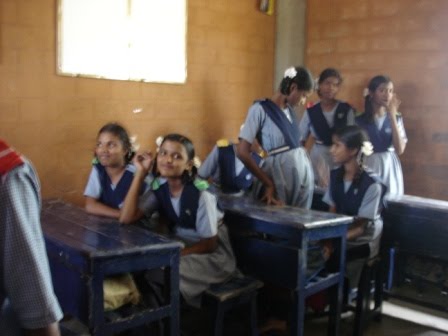
I seriously want to punch the person/people who came up with the 10th class exams. The schoolkids, up to 10th, have tons of enthusiasm, are filled with questions, and can actually learn. After 10th, they turn into zombies who may eat brains but have none of their own.
I might be exaggerating a little. They probably don't eat brains.
I'm jumping forward in time from my narrative, but I had to get this off my chest. We visited a degree college here in Hyderabad today, and talked to some of the teachers.
These students are getting Bachelors degrees in Biochemistry, Microbiology, and the like. And yet they have no clue how to formulate an answer from information they know. All they know is the answers, word-for-word, to the questions in their study guides. One of the teachers told us what happened when she asked something very simple of them: "Describe the room we are sitting in."
She was looking for something along the lines of, "It has one door" or "There are four windows" or "There are desks in the center". What she got was silence. And then one of the braver students asked, "You tell us first, ma'am. Then we'll tell."
They are no more than parrots, though their squawking sounds more like "DNA is transcribed into RNA" than "Polly want a cracker!"
Why is this?
I've come up with a few reasons, but the major one is the tests. The questions on the tests must be exactly the same as the ones in the books. I'm serious. Even math problems.
Forget changing the numbers; if the math problem in the book says "Sammy has 4 apples..." and you change it to "Sammy has 4 bananas...", it becomes out-of-syllabus! That's not allowed on the exams. So what do teachers do? They have the students write out each of the allowed problems 20 times, the students memorize them, and regurgitate the ones that show up on the exam, and nobody ever learns anything.
Up until 5th grade, kids can't fail. And many schools have requirements that teachers can't let their students get below 80 marks (out of 100) or something like that. So the tests are basically rigged so that everyone passes. The students get good marks, and then they don't even realize that they know absolutely nothing. After all, they got good grades!
Example anecdote: A new teacher, who happened to be a scientist mother on leave, agreed to teach UKG (kindergarten) at her son's school. So she did. After the first month, the kids had unit tests. Some of her kids got as low as 40 marks, and the headmaster and other teachers came after her and asked just what she was teaching. She told them numbers, colors, etc. Well, in UKG, apparently, teachers are supposed to teach three colors: red, green, and yellow. That's all they're supposed to teach on that subject, grinding it into the kids' heads for a week. Since that's all the kids are tested on, they do great on the tests. And then they have no idea that there are more than 3 colors in the world. And any kid who answers "blue" on his homework gets the answer wrong.
If the kids aren't getting high enough marks, the parents threaten to switch their kids to another school, regardless of whether the marks actually mean anything.
The problem is, this isn't simply up to 5th grade. The tests are like this all the way through college. The state syllabus is actually not that bad, though the science is quite outdated (anybody who quits after high school will know not a single fact about DNA or genes or genetic diseases). But because of the nature of the tests, nobody learns even what little is there. They study, study, study the answers to the questions they know will be asked, with no idea what they mean and no idea how to answer if a single word is changed.
That's the state of education in the state of Andhra Pradesh. There is no creativity. And it's not even about creativity in the form of art or music - many of the older students lack the ability to form a coherent thought of their own! But how can they help it? After all, any sort of independent thinking is systematically beat out of them.
I respect the RDF even more now for trying to encourage some creativity in their kids. Hopefully they'll grow up to be leaders someday and change the whole thing from the inside out.
Friday, July 30, 2010
Thursday, July 29, 2010
Day 24 - The First of the Last (Kalleda)
The Golconda Express leaves the Secunderabad Junction station at 1 pm and arrives at Nekkonda, just past Warangal, at about 4 pm. Trains, of course, tend to be late, so by the time we arrive, it's about 4:45. A school auto picks us up and takes us to the village of Kalleda, which is located on a well-traveled road (buses lumber by every half hour or so).
The school here is housed in an old house built in 1936. It's more of an estate, really, like a zamindar's house.
Since the house was not being used much, the many-branched family that started the RDF donated the building for the purpose of the school. It's impressive, but it feels like a bit more like a house and a bit less like a school.
And this giant mansion surrounded by 15-20 foot white walls in the middle of a village of small houses and huts also feels like a symbol of past oppression.
There's a reason Naxalites came into being, and this really seems like a great example of it. But the family donated the house and is very involved in funding and maintaining the school, so their intentions now are good, and I support that. Apparently, so do the Naxalites now, according to a story from the founding of the Matendla school:
The school here is housed in an old house built in 1936. It's more of an estate, really, like a zamindar's house.
Since the house was not being used much, the many-branched family that started the RDF donated the building for the purpose of the school. It's impressive, but it feels like a bit more like a house and a bit less like a school.
And this giant mansion surrounded by 15-20 foot white walls in the middle of a village of small houses and huts also feels like a symbol of past oppression.
There's a reason Naxalites came into being, and this really seems like a great example of it. But the family donated the house and is very involved in funding and maintaining the school, so their intentions now are good, and I support that. Apparently, so do the Naxalites now, according to a story from the founding of the Matendla school:
On one occasion, when members of RDF were travelling to Matendla for a site appraisal, the group was accosted by a Naxal supporter armed with several grenades and a rifle slung across the handlebars of his bicycle. The man escorted the group to meet his leader who demanded to know why they had visited the area. “When we told him why we were there, he not only extended his support to the project, but also promised a donation of Rs. 10,000 towards the school,” says [the current CEO of the RDF] E. Vandita Rao, who was part of the group.
Wednesday, July 28, 2010
Day 21 - The Last of the First
Today is my last full day at Matendla. We're going to do a couple labs, take care of the English classes, and say bye to the kids. Tomorrow morning, we'll catch the bus to Siddipet and then another bus from there to Jubilee Hills in Hyderabad, from where we will have to take an auto to get home.
We start in the morning with the 10th graders, doing that Bullseye lab (for projectile motion) that we did in Mr. Robinson's class in high school. Unfortunately, without a smooth, relatively frictionless ramp, the calculations don't quite work out. We turn it into a lesson on how science doesn't work a lot of the time, and how you can work backward from what you find to figure out why it didn't work. Well, at least the kids had fun playing with marbles.
The 8th graders have their turn with surface tension next. We only have a limited number of boats, so we pick popsicle sticks with their names. Some boats move successfully, while others don't. Perhaps a slightly less concentrated soap solution would work better next time.
Not everyone gets to try a boat, but still, they look pretty happy when the boats actually move. If nothing else, they're excited about the camera :D
After school is the last English class. The kids have been falling over Curious George, The Beauty and the Beast, Thumbelina, and Mickey and Friends like piranhas. As soon as the lesson is over and it's time for reading, there is a veritable riot as they scramble for the 15-20 books we have. There still aren't enough, so they read in groups. They're asking fewer questions of us, which I hope means they're understanding more words, but I still see some writing down words they don't know to look up later. That's the best way to do it!
We start in the morning with the 10th graders, doing that Bullseye lab (for projectile motion) that we did in Mr. Robinson's class in high school. Unfortunately, without a smooth, relatively frictionless ramp, the calculations don't quite work out. We turn it into a lesson on how science doesn't work a lot of the time, and how you can work backward from what you find to figure out why it didn't work. Well, at least the kids had fun playing with marbles.
The 8th graders have their turn with surface tension next. We only have a limited number of boats, so we pick popsicle sticks with their names. Some boats move successfully, while others don't. Perhaps a slightly less concentrated soap solution would work better next time.
Not everyone gets to try a boat, but still, they look pretty happy when the boats actually move. If nothing else, they're excited about the camera :D
After school is the last English class. The kids have been falling over Curious George, The Beauty and the Beast, Thumbelina, and Mickey and Friends like piranhas. As soon as the lesson is over and it's time for reading, there is a veritable riot as they scramble for the 15-20 books we have. There still aren't enough, so they read in groups. They're asking fewer questions of us, which I hope means they're understanding more words, but I still see some writing down words they don't know to look up later. That's the best way to do it!
Thursday, July 22, 2010
Day 20 - Architecture
So you've seen a little bit of the architecture of the school, right? It's a nice example of sustainability. The red bricks were all made by the parents and students when the school was first built, from locally available materials.
The doors are all carved from locally available wood, and if the door frames (for those doors that have them) don't match up and the doors don't close completely, it's okay because it's a school, not a private house. For the relative cost, and the purpose of keeping students out of the rain, it mostly works. And rain isn't usually the problem in this part of AP. Actually, it's not just Telangana - having too much rain's not really a problem in many parts of the state.
The openness of the place is most useful for letting the wind through on hot days. The construction is well-suited for that.
The whole point of this is that the school was built cheaply and sustainably (and with the community's involvement, which keeps them invested in sending their kids to school). Because of that, a group of 138 architecture from Hyderabad have come to see the school. They arrive in three busloads and walk around measuring everything with their handy tape measures.
After they've eaten lunch, they sit down along the corridor for a while as the headmasters and teachers talk a little bit about the RDF, the school, and their philosophy of teaching. Some of them don't understand Telugu, but they pay attention when my mom and I are given the microphone since we speak mostly in English.
The school needs more volunteers, especially people who can talk to the students in English, and I say as much. I hope we've inspired at least a couple of them to come back when they have a holiday and help out at the school. Afterward, a pair of students come up to my mother and say that they will in fact come volunteer. The teachers also say that they will talk with and remind the students even after they go back. So I guess it's worked, at least a little bit. Having college students from Hyderabad as volunteers is much more sustainable for the school and useful for the kids (since these college students know how the Indian school system works). I hope they follow up on this.
P.S. I'm going to be spending the rest of the day writing up the procedures for all of the experiments I've done that I didn't bring with me. I only have a couple more days here, and I want to make sure the teachers have everything they need to continue doing the experiments. They've been sitting in on the classes and helping me explain things in Telugu to the students, but it's nice to have a written copy.
The doors are all carved from locally available wood, and if the door frames (for those doors that have them) don't match up and the doors don't close completely, it's okay because it's a school, not a private house. For the relative cost, and the purpose of keeping students out of the rain, it mostly works. And rain isn't usually the problem in this part of AP. Actually, it's not just Telangana - having too much rain's not really a problem in many parts of the state.
The openness of the place is most useful for letting the wind through on hot days. The construction is well-suited for that.
The whole point of this is that the school was built cheaply and sustainably (and with the community's involvement, which keeps them invested in sending their kids to school). Because of that, a group of 138 architecture from Hyderabad have come to see the school. They arrive in three busloads and walk around measuring everything with their handy tape measures.
After they've eaten lunch, they sit down along the corridor for a while as the headmasters and teachers talk a little bit about the RDF, the school, and their philosophy of teaching. Some of them don't understand Telugu, but they pay attention when my mom and I are given the microphone since we speak mostly in English.
The school needs more volunteers, especially people who can talk to the students in English, and I say as much. I hope we've inspired at least a couple of them to come back when they have a holiday and help out at the school. Afterward, a pair of students come up to my mother and say that they will in fact come volunteer. The teachers also say that they will talk with and remind the students even after they go back. So I guess it's worked, at least a little bit. Having college students from Hyderabad as volunteers is much more sustainable for the school and useful for the kids (since these college students know how the Indian school system works). I hope they follow up on this.
P.S. I'm going to be spending the rest of the day writing up the procedures for all of the experiments I've done that I didn't bring with me. I only have a couple more days here, and I want to make sure the teachers have everything they need to continue doing the experiments. They've been sitting in on the classes and helping me explain things in Telugu to the students, but it's nice to have a written copy.
Day 18 - Home
Initially, I was supposed to do 2 weeks and Matendla and 2 weeks at Kalleda. But the headmaster, teachers, and students asked us to stay here an extra week. Kalleda gets plenty of visitors (including a small group of WashU students at the junior college every July), but Nik and I were the first ones to visit Matendla this whole year. As far as I know, the last visitor before that was Nik's sister Bella, who stayed for three weeks last summer and then went home and raised Rs. 14,00,000 (yes, the comma is in the right place - that's read as 14 lakhs) or about € 20,000 for Matendla. Impressive.
At any rate, we went home on Saturday afternoon and planned to come back Monday morning. Unfortunately, my mom got sick, and then I caught a light case of whatever she had with a two-day delay. So by the time we finally get back to Matendla, it's Wednesday. We can take the evening English class, I guess, but we've missed the morning one and the actual school period (which my mom has been taking over since the English teacher spot is vacant).
Day 13 - Magnets
It's really difficult to make the iodine clock reaction work when you have no balances and therefore no idea what the molarity of your solutions really are. Magnets, on the other hand, work perfectly well without balances. Nik found some magnets and a little packet of iron filings before he left on Sunday, so we're going to do magnetism for the 8th and 9th graders since it's in their curriculum (though all the pictures here are of 8th).
The kids have divided into their groups, and I give each a little box with some iron filings spread out. After a little introduction to magnets (with the help of a compass), I hand each group a bar magnet, and have them play with getting a field pattern in the filings.
When I go around and tap the box as it rests atop the magnet, the filings fall into place and the kids eyes widen. "Look, it's making a pattern!"
Now to explain the why, and how the field goes from north to south in all directions and how we can find what the field looks like by looking at the pattern in the filings.
And now a little induced magnetism to end the lesson. Iron piece = not magnetic. Iron piece + magnet = magnetic. Take off the magnet, and the filings fall off the iron piece again. It's like mag(net)ic!
The kids have divided into their groups, and I give each a little box with some iron filings spread out. After a little introduction to magnets (with the help of a compass), I hand each group a bar magnet, and have them play with getting a field pattern in the filings.
When I go around and tap the box as it rests atop the magnet, the filings fall into place and the kids eyes widen. "Look, it's making a pattern!"
Now to explain the why, and how the field goes from north to south in all directions and how we can find what the field looks like by looking at the pattern in the filings.
And now a little induced magnetism to end the lesson. Iron piece = not magnetic. Iron piece + magnet = magnetic. Take off the magnet, and the filings fall off the iron piece again. It's like mag(net)ic!
Wednesday, July 21, 2010
Day 12 - Resistors and Circuits
We tried a lot of stuff yesterday, including making a lemon battery and changing the color of a color-changing LED we found. Today, we played around a little with circuits and resistors today in the 10th grade science class.
We basically took a resistance box and had the kids pull out keys (therefore adding resistance) and put them back to see the effect on the intensity of the light bulb. We had a color-changing LED as well, but that burnt out in the beginning of the second class (the 10th class is divided into two sections). At least everybody got to see it once.
The girls are sitting on their side of the classroom, waiting patiently, but...
ZOOM! As soon as it's their turn, they're up like they've been stung by fire ants. It's good to see that enthusiasm.
And enthusiasm is certainly not lacking here. A couple days ago, some of the students came up to us as we were talking to the headmaster and asked if we would teach an English class. My mom agreed to take a class from 8:30-9:30 (the hour before school) and 5:30-6:30 (the hour after school), so I'll help her out with that a little bit. The class will be both sections of 10th, and 50+ students is a tad difficult for one teacher.
The 10th graders want a little more help because they need to take their 10th class exams at the end of the year, and as much as they say they like English, it's not their strong suit. Who can blame them? The school is Telugu medium as of now (meaning all the classes are taught in the medium of Telugu), and they are one English teacher short of a full teaching staff.
We basically took a resistance box and had the kids pull out keys (therefore adding resistance) and put them back to see the effect on the intensity of the light bulb. We had a color-changing LED as well, but that burnt out in the beginning of the second class (the 10th class is divided into two sections). At least everybody got to see it once.
The girls are sitting on their side of the classroom, waiting patiently, but...
ZOOM! As soon as it's their turn, they're up like they've been stung by fire ants. It's good to see that enthusiasm.
And enthusiasm is certainly not lacking here. A couple days ago, some of the students came up to us as we were talking to the headmaster and asked if we would teach an English class. My mom agreed to take a class from 8:30-9:30 (the hour before school) and 5:30-6:30 (the hour after school), so I'll help her out with that a little bit. The class will be both sections of 10th, and 50+ students is a tad difficult for one teacher.
The 10th graders want a little more help because they need to take their 10th class exams at the end of the year, and as much as they say they like English, it's not their strong suit. Who can blame them? The school is Telugu medium as of now (meaning all the classes are taught in the medium of Telugu), and they are one English teacher short of a full teaching staff.
Subscribe to:
Posts (Atom)